We Asked Job Seekers About Their Biggest Frustration and The Results Are a Reality Check for Employers
At HERO Recruitment, we like to keep our finger on the pulse of the market by listening to candidate feedback to understand what is really happening on the ground, so we recently conducted a poll asking a simple but important question:
What’s your biggest frustration when job searching?
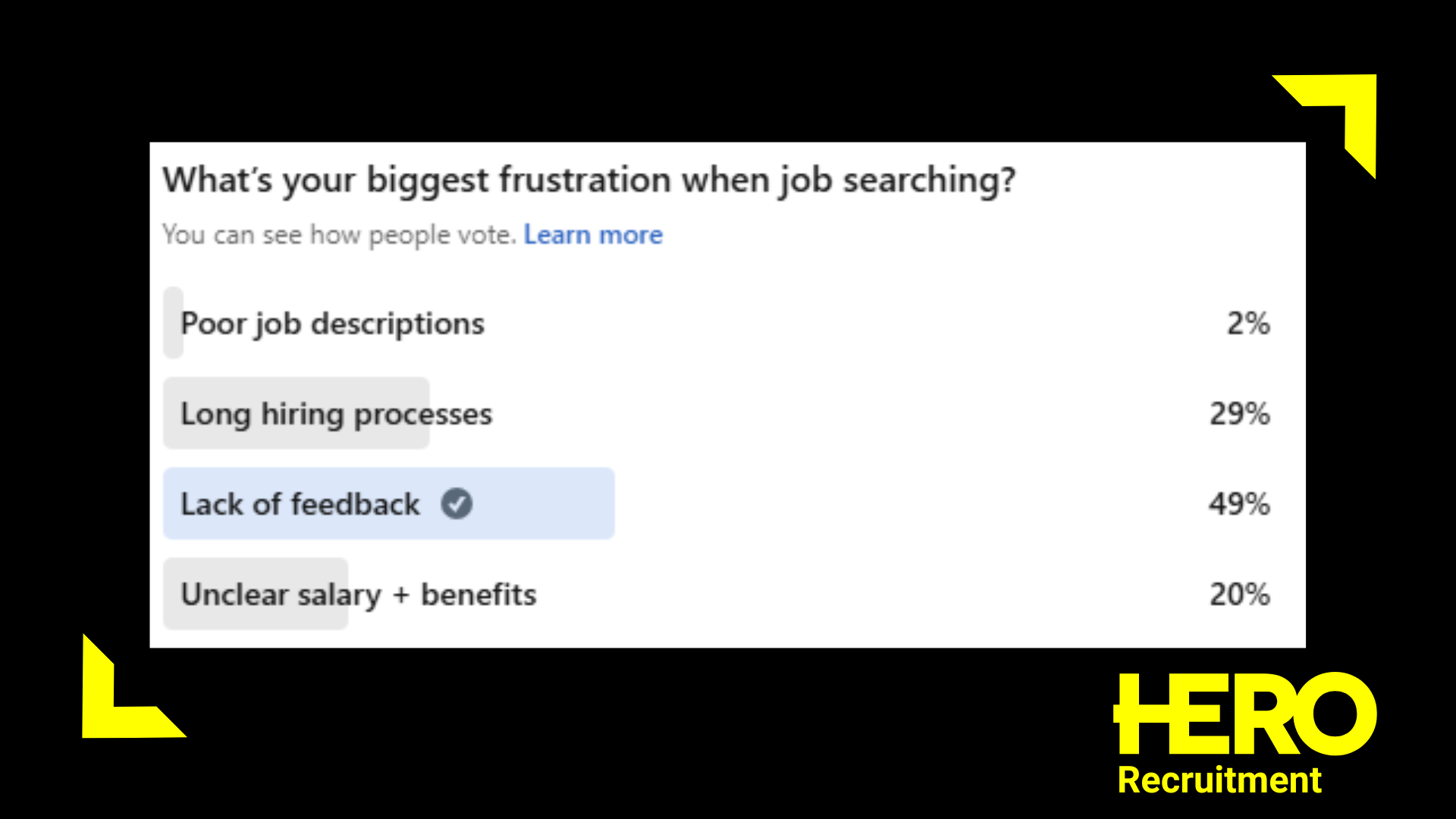
The responses were telling:
- Lack of feedback- 49%
- Long hiring processes- 29%
- Unclear salary + benefits- 20%
- Poor job descriptions- 2%
On the surface, these are candidate frustrations. But looked more closely, they are a reality check for employers, especially in Ireland, where the market is small, reputations travel fast, and candidate experiences are quickly shared.
Because when candidates talk about what frustrates them, they are also talking about how companies are being experienced in the market.
And that matters.
A hiring process is not just an internal workflow. It is an external expression of your company. It shapes how people perceive your standards, your culture, your communication style, and your respect for talent.
That is why these poll results are worth paying attention to.
Lack of feedback is not a small issue, it is a brand issue
With 49% of respondents selecting lack of feedback, this was by far the biggest frustration in the poll. Candidates understand that they will not get every role. Most people can accept that. What is much harder to accept is silence.
No response after applying. No update after the interview. No clarity on where things stand. From the employer side, that may be explained as lack of time, internal delays, or competing priorities. From the candidate side, it often feels disregarded.
And that perception can do lasting damage.
Because candidates do not separate the hiring process from the employer brand. To them, the process is part of the brand. In Ireland’s STEM market, where demand for skilled professionals is expected to grow strongly, employers cannot afford to lose credibility during the hiring process. HERO’s insights point to a 22% increase in STEM job opportunities between 2022 and 2030, underlining just how competitive the talent market has become. A poor employer brand or negative candidate experience can stop strong talent from applying or cause them to accept another offer instead.
That does not just mean losing a hire. It can mean losing the person who would have strengthened your next product launch, improved delivery timelines, or helped keep a critical compliance project on track.
If communication is weak during recruitment, candidates may reasonably assume communication is weak internally too. If the process feels disorganised, they may assume the business is disorganised. If they feel undervalued before they join, they may decide they do not want to join at all.
Long hiring processes create doubt before day one
The second biggest frustration in the poll was long hiring processes, chosen by 29% of respondents. Again, this is about more than inconvenience. A long hiring process often creates uncertainty at exactly the point where employers should be building confidence.
It is also worth looking at this from the candidate’s side. For many people, attending interviews is not a small commitment. They may be taking a half day off work, using precious annual leave, arranging childcare, travelling to meet the employer, and spending hours preparing beforehand. That is a significant investment of time and energy, often at the expense of time they would otherwise spend with family, friends, or simply recharging.
When a process then drags on without updates or clear direction, candidates can feel that their time has not been respected.
The longer a process drags on, the more likely candidates are to wonder:
- Is this company decisive?
- Do they know what they want?
- Is this role genuinely a priority?
- What would it be like to work in an environment where everything moves this slowly?
For employers, slow hiring often feels like caution. For candidates, it can feel like hesitation, confusion, or bureaucracy. In competitive sectors, hesitation comes at a cost. Strong candidates do not stay available indefinitely. They move toward the organisation that gives them confidence and clarity.
Pay transparency is moving from expectation to requirement
20% of respondents selected unclear salary and benefits as their biggest frustration. This matters because transparency is increasingly tied to credibility.
Experienced talent is already on a package and wants to know early whether a role is worth pursuing. If salary and benefits are left vague, employers risk losing credibility before the process has properly begun.
This is becoming more important not just from a candidate experience perspective, but from a policy perspective too. The Department of Enterprise, Tourism and Employment has noted that the Pay Transparency Directive is to be transposed into Irish law by June 2026, further strengthening transparency in pay setting and enforcement structures.
We understand that greater transparency can raise internal questions, particularly where existing employees may compare packages more closely. But that is exactly why this shift matters. In the long term, pay transparency pushes organisations towards greater fairness, clearer pay structures, and stronger trust with both current employees and future hires.
This is especially important in a market where senior and specialist STEM (Science Technology, Engineering and Mathematics) candidates weigh not just base salary, but also benefits, flexibility, progression, scope, and long-term fit. A lack of clarity early on can make the entire process feel less trustworthy.
How this connects directly to brand image
Employer brand is not built only on careers pages, LinkedIn content, or polished messaging. It is built in the moments where candidates interact with the business directly.
That includes:
- how quickly they hear back
- how clearly the process is explained
- whether expectations are managed properly
- whether interviews feel organised and respectful
- whether they receive closure
Every one of those moments shapes a brand image.
A company may want to be seen as innovative, people-first, high-performance, or values-led. But if the hiring process tells a different story, candidates will believe the process over the messaging.
What good employers do differently
The best hiring experiences are not always the most elaborate. Usually, they are simply the most considered.
Good employers tend to:
- communicate clearly
- move with purpose
- respect the candidate’s time
- set realistic expectations
- close the loop properly
These are not just process improvements. They are reputation builders. If your hiring process is creating friction, it may also be affecting how your brand is perceived in the market. Talk to us at HERO about creating a candidate experience that reflects the standards of your business. Reach out to us on (091) 730 022 or email hello@hero.ie.





Search Jobs
Match my CV
We take the hard work out of finding you a new job. Simply upload your CV (or call us) and we’ll get hunting for you!
Subscribe to The Shift for the latest STEM industry and career updates.

Join The Shift!
Get insider updates on the hottest industry trends, cutting-edge career advice, and exclusive talent insights. Stay ahead of the curve and keep your finger on the pulse of Ireland’s STEM talent trends. Exciting content coming your way soon!