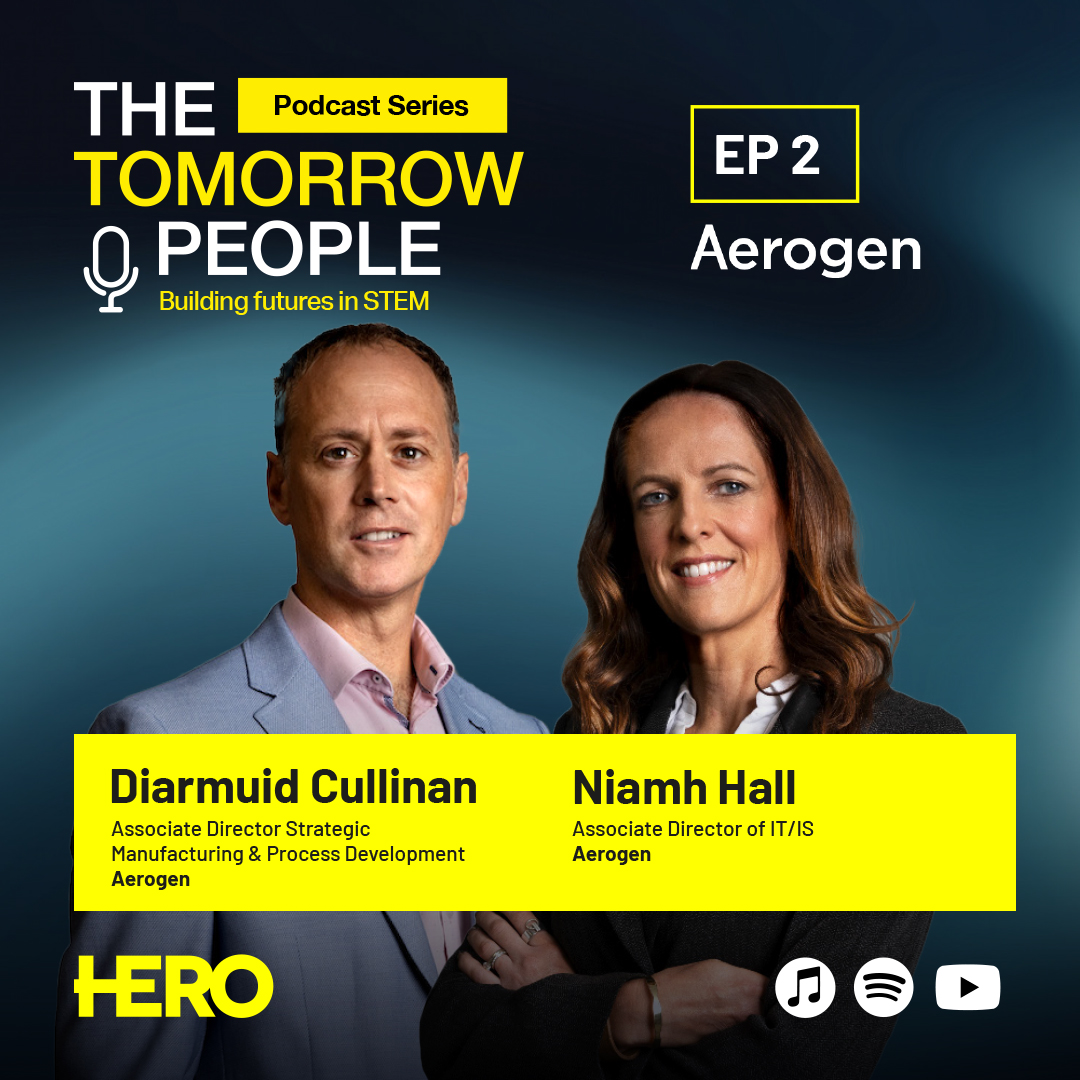
Ep 2 | Aerogen: AI Won’t Take Your Job, But It Will Redesign It
Aerogen’s Diarmuid Cullinan and Niamh Hall on what AI is actually doing to engineering and technology careers right now, the entry-level work it is rewriting, the one skill nobody is teaching any more, and why the company that gives you the most influence isn’t always the biggest one.
AI is already changing how work gets done. Does that mean people should feel excited, or threatened?
In this episode of The Tomorrow People, host Deirdre Finnerty speaks with two senior leaders at one of Ireland’s fastest-growing medtech companies: Diarmuid Cullinan, who came up through industrial engineering and a decade in product management and now leads strategic manufacturing and process development at Aerogen, and Niamh Hall, who joined as the company’s ninetieth employee, with no IT department to join because she was the IT department, and now leads a team across IT, AI, cybersecurity and a new ERP programme.
Diarmuid starts somewhere more practical: with what the engineering role itself now has to include. The fundamentals have not moved, the technical base, the curiosity, the disciplined problem solving. The boundaries around the job have.
“It’s not good enough to know your engineering space and just focus on that. You have to know how it integrates with the wider organisation, back into R&D, out onto the production floor, into the digital systems you’re connecting to. … You can’t just be an engineer in the corner working on your single project.”
Which leads to the uncomfortable question underneath it. If the narrow, self-contained work is the first thing the technology absorbs, what happens to the entry-level tasks through which people traditionally gained their experience?
Niamh’s answer is the reassuring one. She has seen this twice before, and both times the panic was aimed at the job title rather than the work underneath it.
“When Google came in, people said we don’t need an IT support desk any more. When cloud services came in, they said we wouldn’t need server or network engineers. They’re all still needed, it’s just designed differently. The job specs are redesigned.”
Her real concern lies elsewhere: that people are backing away from technology and engineering courses because they have decided the jobs will not be there.
Episode highlights:
-
What AI actually changed on the ground, three months of work done in one, and what that costs
-
Why the entry-level role is being redesigned rather than deleted, and how internal knowledge shares keep junior people in the room
-
How a company that isn’t a household name still wins the people it wants
-
The one skill Niamh worries about most, and it isn’t a technical one
-
Whether the four-year degree still holds up, and why some of Aerogen’s best people don’t have one
-
How sustainability targets are quietly pulling manufacturing into digitalisation, and what that asks of a mechanical engineer
If you are building a career in engineering or technology, or building the team around one, this conversation will change how you think about the next five years.
A huge thank you to our sponsor, Fenero, a multi-award-winning company specialising in financial success for contractors, freelancers, and solopreneurs.
For more updates, follow HERO Recruitment on LinkedIn, reach out to hello@hero.ie, or explore exciting job opportunities in STEM (Science, Technology, Engineering and Maths): Permanent Job Opportunities and Contracting Job Opportunities.
FAQs
Episode two of The Tomorrow People features Diarmuid Cullinan, Associate Director of Strategic Manufacturing and Process Development at Aerogen, and Niamh Hall, Associate Director of Information Technology and Digital Transformation at Aerogen. Diarmuid came up through industrial engineering and a decade in product management, running a global product line across Ireland, China, Singapore and California. Niamh joined Aerogen ten years ago as its ninetieth employee, when there was no IT department to join, and now leads a team across IT, AI and cybersecurity. The host is Deirdre Finnerty, Recruitment and Talent Director at HERO Recruitment.
Episode two of The Tomorrow People asks what artificial intelligence has actually changed in engineering and technology work, rather than what the headlines say it has changed. Diarmuid Cullinan and Niamh Hall of Aerogen discuss what AI has done to everyday engineering tasks, why entry-level roles are being redesigned rather than deleted, what a degree is worth when no curriculum can keep pace with the technology, how sustainability targets are pulling manufacturing into digitalisation, and the one skill they both worry about most, which is not a technical one.
No. Entry-level roles are more likely to be redesigned than removed. On episode two of The Tomorrow People, Niamh Hall, Associate Director of Information Technology and Digital Transformation at Aerogen, points to two earlier moments when the same prediction was made: "When Google came in, people said we don't need an IT support desk any more. When cloud came in, they said we wouldn't need server or network engineers. They're all still needed. The job just got redesigned." Her view is that the routine tasks change while the need for people does not: "It's not that entry-level jobs are going. They'll just be different."
Yes, and the risk runs the other way. On episode two of The Tomorrow People, Niamh Hall, Associate Director of Information Technology and Digital Transformation at Aerogen, names the pattern she finds most worrying: "People are saying, I won't need to go there, because AI will do it. They're reluctant to go into technology and engineering. That's my fear, that people are backing away because they don't think there will be roles." Her advice to anyone weighing up a course: "If it's something you're interested and keen in, drive for it. It will change, but there will be a job there."
Technical depth still matters, but on its own it is no longer enough. On episode two of The Tomorrow People, Diarmuid Cullinan, Associate Director of Strategic Manufacturing and Process Development at Aerogen, describes what has changed: "The fundamentals remain the same. We still want the technical base, the curiosity, disciplined problem solving. But it's not good enough to know your engineering space and just focus on that. You have to know how it integrates with the wider organisation, back into R&D, out onto the production floor, into the digital systems you're connecting to." Niamh Hall names the one she worries about most, and it is not technical: "The big thing, and the sustaining thing, is soft skills."
A degree helps, but it is not the only route. On episode two of The Tomorrow People, Diarmuid Cullinan, Associate Director of Strategic Manufacturing and Process Development at Aerogen, is direct about it: "Some of the best employees we have don't have a degree, and they're well recognised in the organisation as the go-to person. I wouldn't lose faith in not having your level 8." He points to apprenticeships, Level 6 and Level 7 qualifications and micro-credentials, and to Irish state supports including Skillnet. Niamh Hall adds that a degree is a beginning rather than a conclusion: "The changing of technology can't keep up with the curriculum of a degree or a master's. It's the start of your education, not the end of it."
Sustainability reporting is pulling manufacturing equipment onto the network. On episode two of The Tomorrow People, Diarmuid Cullinan, Associate Director of Strategic Manufacturing and Process Development at Aerogen, traces it through the emissions scopes: direct fuels eliminated, then power consumption digitalised, connected and monitored. "It comes back to connectivity and systems thinking. It's not just the process and the piece of equipment running production." The example that makes it concrete is predictive maintenance: "When an electric motor is wearing, you can see the power consumption go up, so now you replace it before it causes major downtime." Supply chain emissions are addressed through design: reducing packaging, reducing precious metals and improving yields.
Governance is the part most organisations underestimate. On episode two of The Tomorrow People, Niamh Hall, Associate Director of Information Technology and Digital Transformation at Aerogen, argues that the G in ESG is routinely overlooked: "The social side, AI bias, the EU AI Act. Making sure anything you build or put into your systems is auditable and trained correctly." She also notes the energy question sitting behind the technology: "We're all conscious of what AI is doing and the power consumption behind it." For manufacturers deploying AI in regulated environments, auditability and training data are governance obligations rather than technical preferences.
Speed and ownership, rather than salary. On episode two of The Tomorrow People, Niamh Hall, Associate Director of Information Technology and Digital Transformation at Aerogen, has worked both sides: "Because we're headquartered in Ireland and we have the autonomy to make the decisions in our own department, we can see the difference quicker. In a multinational you could be going down a channel for years before the impact is seen." She also points to what candidates now weigh up: "People now look at what the company stands for, not just the job they're doing." Aerogen sees interns return as graduates, having seen the mark they could leave at that size.
Episode two of The Tomorrow People, featuring Diarmuid Cullinan and Niamh Hall of Aerogen, was released on Tuesday 6 October 2026 and is available on Spotify, Apple Podcasts and on this page. The Tomorrow People is HERO Recruitment's High Flyers in STEM series, hosted by Deirdre Finnerty, and is sponsored by Fenero, a multi award winning company specialising in financial success for contractors, freelancers and solopreneurs.