Ep 3 | ProVerum: Why AI Won't Replace Judgment in a Regulated Industry
What does each side of the multinational and start-up line really give an engineer?
ProVerum’s Gordon Crowley and Amy Murr on why AI can’t replace human judgment in a regulated industry, where specialist contracting genuinely earns its place, and what a hundred AI-polished CVs look like from the other side of the desk.
A start-up will hand you a variety of experiences you would wait ten years for in a multinational. It will also hand you uncertainty.
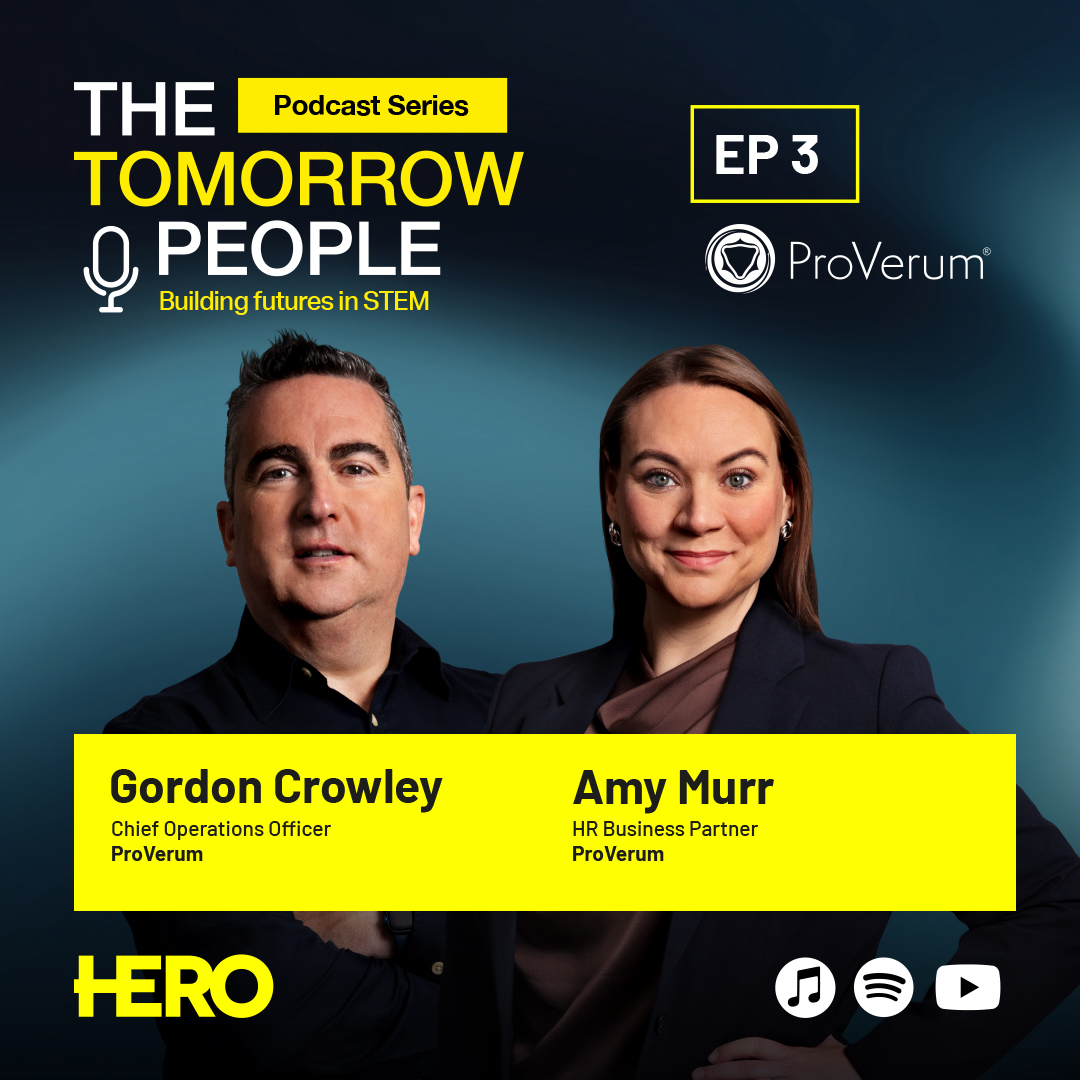
In this episode of The Tomorrow People, host Deirdre Finnerty speaks with two leaders from ProVerum: Gordon Crowley, Chief Operating Officer, who has spent close to thirty years in medical devices across MedNova, Abbott and Novate, and is now part of a business whose ProVee device, for the treatment of BPH, gained FDA approval last year and is selling in the United States; and Amy Murr, who arrived from Australia this year with twenty years in HR behind her and is helping to build ProVerum’s team across Galway, Dublin and the US.
Gordon is even-handed about the two environments.
“If a large company gives you systems and frameworks, a small company gives you first-principles thinking. There’s no SOP, no manual, no divisional subcommittee to escalate to. You’re driving the train and laying the tracks at the same time.”
His advice is to do both, in order. Build the technical foundation somewhere you can see what good looks like, then take it somewhere you can actually influence.
On AI, he makes an argument you will not hear often: the anxiety is justified, but aimed at the wrong target.
“In the medical device industry, AI isn’t going to replace human judgment. And it isn’t going to, because the regulatory framework won’t allow it. You need, as a company, to explain and defend your output.”
The risk, in his view, is not the tool. It is the guardrails placed around it, and whether a qualified person still owns the outcome.
Amy brings the people half of the same argument. On culture, she is clear that if you are not deliberate a culture will form anyway, and it might not be the one you wanted to build. On the mistake early-career people make, it is waiting to be told what to do. And on hybrid working, her focus is on output rather than optics. Good leaders, as she puts it, don’t manage visibility.
Episode highlights:
-
What start-ups and multinationals each offer at different stages of an engineering career
-
How skills in design, process validation, manufacturing and quality support a growing medtech business
-
Why specialist contracting can be a deliberate strategic choice at key development stages, rather than a workaround
-
How initiative, thoughtful questions and evidence of real project work help candidates stand out
-
Why AI can’t take the judgment out of a regulated industry, no matter how fast the work gets
-
Why mentoring, relationships and purposeful time on site still matter for learning
A grounded conversation for anyone building a career in medical devices, or building the team behind one.
A huge thank you to our sponsor, Fenero, a multi-award-winning company specialising in financial success for contractors, freelancers, and solopreneurs.
For more updates, follow HERO Recruitment on LinkedIn, reach out to hello@hero.ie, or explore exciting job opportunities in STEM (Science, Technology, Engineering and Maths): Permanent Job Opportunities and Contracting Job Opportunities.
FAQs
Episode three of The Tomorrow People features Gordon Crowley, Chief Operating Officer at ProVerum, and Amy Murr, HR Business Partner at ProVerum. Gordon has spent close to thirty years in medical devices, taking products from concept through to commercialisation and acquisition at Mednova, Abbott and Novate. ProVerum's ProV device has received FDA approval and is now selling in the United States. Amy joined ProVerum this year from Australia, bringing twenty years in HR across global mining and professional services, and is building the company's team across Galway, Dublin and Minnesota. The host is Deirdre Finnerty, Director of Recruitment and Talent HERO Recruitment.
Episode three of The Tomorrow People asks what a career in medical devices really teaches you, and what building a company asks of the people inside it. Gordon Crowley and Amy Murr of ProVerum discuss what a multinational gives you that a start-up cannot and the reverse, why the anxiety about AI may be aimed at the wrong target, why a culture you do not design forms anyway, what an AI-polished CV tells an employer, what early-career professionals lose by not being in the room, and why contracting has become a deliberate strategic choice in the medical device industry.
No, and the reason is structural rather than reassuring. On episode three of The Tomorrow People, Gordon Crowley, Chief Operating Officer at ProVerum, opens with a challenge: "The anxiety about AI is justified. But I think it might be aimed at the wrong target." His reasoning: "In the medical device industry, AI isn't going to replace human judgment. And it isn't going to, because the regulatory framework won't allow it. You need, as a company, to explain and defend your output." The risk, in his view, sits elsewhere: "It's not the tool we should be anxious about. It's how we learn to use the tool, and the guardrails we put around it."
Both, in that order. On episode three of The Tomorrow People, Gordon Crowley, Chief Operating Officer at ProVerum, sets out the trade: "If a large company gives you systems and frameworks, a small company gives you first-principles thinking. There's no SOP, no manual, no divisional subcommittee to escalate to. You're driving the train and laying the tracks at the same time." He is candid about the risk of staying too long in the larger one: "You can get comfortable. The system can carry you, and you can end up executing more than deciding." His advice: "Go to a bigger company first. See what good looks like, build a good technical foundation, then go to a start-up and take that knowledge somewhere you can really have an influence."
Not if you want it to stand out. On episode three of The Tomorrow People, Gordon Crowley, Chief Operating Officer at ProVerum, explains what a CV has always told him: "I loved CVs that were written by the person. They're an example of someone's work, a representation of their communication and their writing." His conclusion: "The irony now is that an AI-polished CV takes that away from the recruiter, but it could take it away from the person applying for the job too. So maybe write your own CV." Amy Murr, HR Business Partner at ProVerum, describes the view from the hiring side: "If we get a hundred applications and eighty of them have clearly been through an AI tool, then the ten or twenty you can tell were written thoughtfully, that's what differentiates you from the pack."
Because the work moves in phases, and each phase needs different expertise. On episode three of The Tomorrow People, Gordon Crowley, Chief Operating Officer at ProVerum, is clear that this is not a fallback: "Contracting is becoming more significant in the medical device industry. And not as a workaround, or a cost-saving measure. For a lot of companies like ourselves, it's a deliberate strategic choice." He explains the logic: "The traditional permanent model works well in a stable environment. But where you're moving through phases, R&D to operations to commercial, you need to bring in the expertise for that phase. Very deep expertise, for a short period, without the structural overhead." Amy Murr, adds that it works for the professional too: "You experience different companies, different ways of working. And it doesn't prohibit permanent conversion."
Deliberately, because the alternative is not no culture. On episode three of The Tomorrow People, Amy Murr, HR Business Partner at ProVerum, who is building the company's team across three locations, puts it plainly: "If you're not deliberate, a culture is going to form anyway, and it might not be the one you wanted to build." Her fixed point is values: "The values are the anchor. Everything around that flexes." She is also direct about what speed does to people when communication falls behind: "Ambiguity at speed creates anxiousness. And most anxious people don't work at their best." Gordon Crowley adds what that asks of leaders: "You need to be protective of it. You need to verbalise it. And you need to live it."
For early-career professionals, more than most people admit. On episode three of The Tomorrow People, Amy Murr, HR Business Partner at ProVerum, describes what gets lost remotely: "Early career especially, you cannot underestimate what you absorb just from being in a room. The informal conversations, watching how decisions get made, picking up on how senior leaders handle pressure and weigh up risk. That's learning you simply can't replicate on a Teams call.
Waiting for instructions. On episode three of The Tomorrow People, Amy Murr, HR Business Partner at ProVerum, names it directly: "Waiting to be told exactly what to do." Her advice runs the other way from performing competence: "Curiosity is a superpower. Nobody expects you to know everything." And, more bluntly: "You don't need to look like you've got it all together. What she sees in the people who progress: "The people who thrive are the ones who are honest about what they don't know, and then move quickly to close those gaps."
Because they compound over a career in a way most technical skills do not. On episode three of The Tomorrow People, Amy Murr, HR Business Partner, at ProVerum, names the skill she expects to matter most in five years: "Communication in all forms, written, verbal, across cultures, across seniority. That's a skill set that compounds." She singles out the habit people avoid: "There's an ease to writing an email or sending a Teams message. Picking up the phone is harder, it's more daunting, but you will build a better relationship having a conversation."
Episode three of The Tomorrow People, featuring Gordon Crowley and Amy Murr of ProVerum, was released on Tuesday 20 October 2026 and is available on Spotify, Apple Podcasts and on this page. The Tomorrow People is HERO Recruitment's High Flyers in STEM series, hosted by Deirdre Finnerty, Recruitment and Talent Director and is sponsored by Fenero, a multi award winning company specialising in financial success for contractors, freelancers and solopreneurs.