Ep 4 | Chanelle Pharma: Where AI Helps in Pharma, and Where Judgement Still Has To
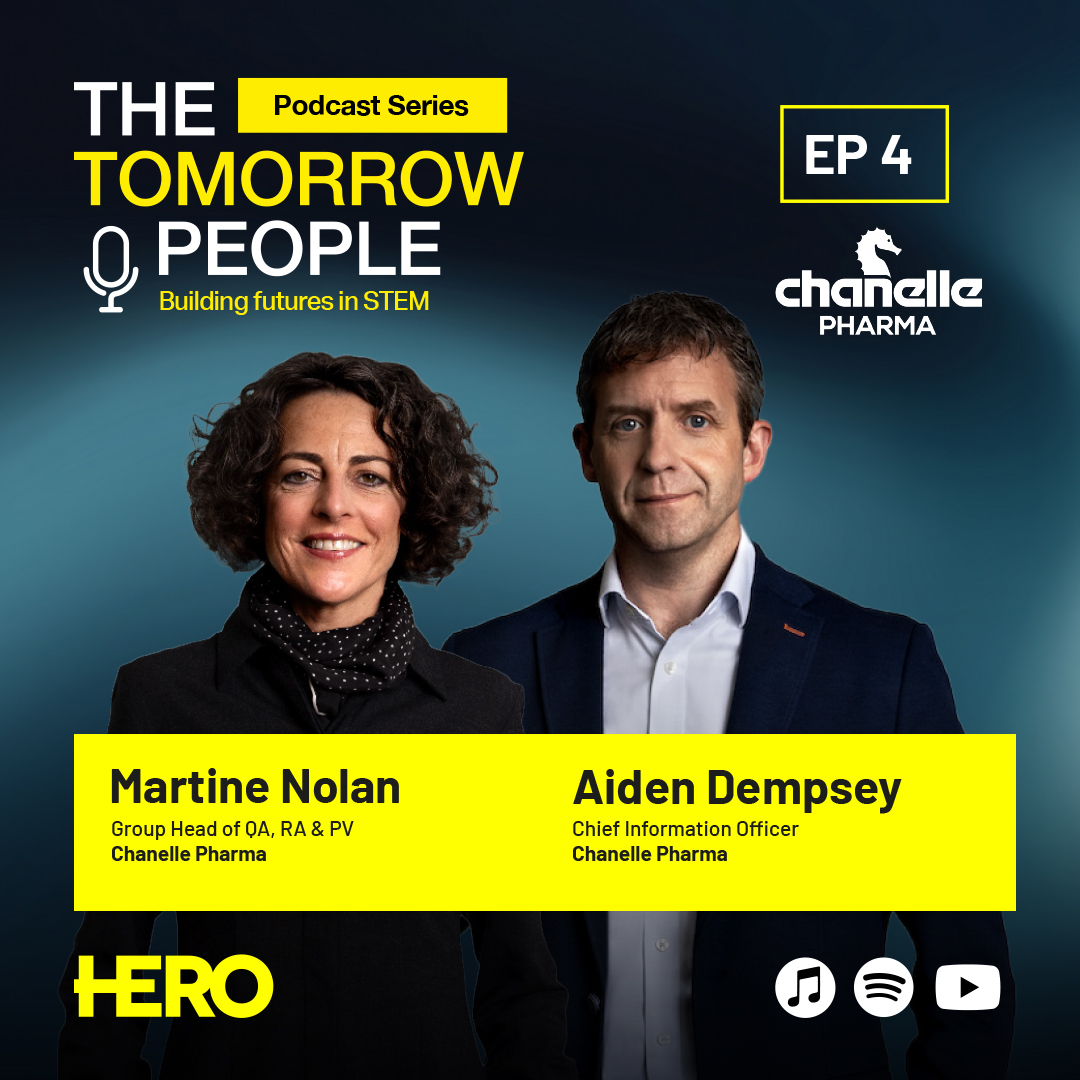
Chanelle Pharma's CIO Aiden Dempsey and head of quality Martine Nolan on what their own AI pilots actually showed, why automating the entry-level tasks risks leaving a generation behind, how a regulated business innovates when everything has to be validated first, and what a contractor has to leave behind to have been worth hiring.
When AI delivers a confident answer, do you have the expertise to challenge it?
In this episode of The Tomorrow People, host Deirdre Finnerty speaks with two leaders from Chanelle Pharma, one of Ireland's largest generic pharmaceutical manufacturers: Aiden Dempsey, Chief Information Officer, whose route into life sciences was never planned, and who credits it with turning a very binary computer science mindset into something far broader"; and Martine Nolan, who has spent her career in pharma and lived in five countries on three continents doing it, moving from the laboratory through validation, manufacturing and distribution into quality leadership.
Most people offer an opinion about AI. Aiden ran the pilots and will tell you what happened both times.
"It's a tool, not a solution. It needs to be done in conjunction with the subject matter."
The implication is not comfortable for anyone hoping the technology is a shortcut. The tool amplifies expertise; it does not substitute for it. Martine comes at the same conclusion from quality, where the stakes are explicit.
"You can't rely on a system to take the accountability. And the system doesn't always get it right. Sometimes the information it presents very confidently might not actually be the right information at all."
They are equally clear that the caution people associate with regulated industries is narrower than it looks. As Martine puts it, there is often a perception that pharma is anti-innovation, and it is not. The caution appears specifically where product quality or patient safety is affected.
The conversation then turns to a harder workforce question. If employers automate the tasks that once trained junior staff, how will they develop the next generation of experts? Aiden's warning is about the horizon rather than the technology: extend it out five years, he says, and there is a real risk that the industry jumps on automation and leaves a generation behind.
Episode highlights:
• What their own AI pilots actually showed, and why subject expertise, data quality and human review decide the outcome
• Why judgement and accountability stay human, no matter how confident the system sounds
• How a regulated business innovates when everything has to be validated first
• Whether we are automating away the roles people learn in, and how internships, project experience and redesigned junior roles
can replace the learning
• Where specialist contractors add value, and why knowledge transfer belongs in the brief rather than the closing meeting
• What quality, regulatory affairs and pharmacovigilance really involve, rather than what people assume
For professionals in engineering, technology, quality, regulatory affairs and operations, this is a grounded look at building a career in pharma as the tools evolve, and at making innovation work while leaving teams stronger after the change.
A huge thank you to our sponsor, Fenero, a multi-award-winning company specialising in financial success for contractors, freelancers, and solopreneurs.
For more updates, follow HERO Recruitment on LinkedIn, reach out to hello@hero.ie, or explore exciting job opportunities in STEM (Science, Technology, Engineering and Maths): Permanent Job Opportunities and Contracting Job Opportunities.
FAQs
The guests are Aiden Dempsey, Chief Information Officer at Chanelle Pharma, and Martine Nolan, Group Head of Quality Assurance, Regulatory Affairs and Pharmacovigilance. Chanelle Pharma is headquartered in Loughrea, Co. Galway, and develops and manufactures generic medicines for human and animal health. Aiden brings deep experience in technology and digital transformation across life sciences, from family-owned businesses to large multinationals. Martine has built a pharmaceutical career across five countries and three continents, spanning validation, manufacturing, distribution and quality leadership. Hosted by Deirdre Finnerty of HERO Recruitment, the episode shares their insights on AI, pharmaceutical innovation, careers and the value of human expertise in a regulated industry.
The episode explores how AI, digital transformation and changing workforce expectations are shaping the pharmaceutical industry in Ireland and beyond. Aiden Dempsey and Martine Nolan of Chanelle Pharma discuss where AI delivers practical value, why human judgement remains essential for product quality and patient safety, and how innovation and regulatory standards work hand in hand. They also cover the skills graduates and experienced professionals will need, how entry-level roles are evolving, and the role specialist contractors play in complex projects. Both share personal career stories and explain why communication, continuous learning and openness to opportunity drive long-term success.
AI is reducing the time pharmaceutical professionals spend on repetitive administrative work, compiling information and processing large volumes of data, so they can focus on review and expert judgement. Aiden Dempsey, Chief Information Officer at Chanelle Pharma, explains that the strongest results come when knowledgeable people guide the technology and critically assess what it produces. He stresses that AI outputs must always be verified, particularly in regulated environments where accuracy matters most. His view is clear: AI is a tool that strengthens human expertise. It does not replace the understanding needed to make reliable decisions.
No. AI can support decision-making in pharmaceutical manufacturing and quality assurance, but decisions affecting product quality and patient safety must remain with appropriately qualified people. Martine Nolan, Group Head of Quality Assurance, Regulatory Affairs and Pharmacovigilance at Chanelle Pharma, explains that these decisions rely on professional judgement, risk assessment and clear accountability. AI can process information quickly and present confident answers, but confidence is not the same as accuracy, so every output must be checked by an expert who understands the wider regulatory context. For Martine, patient safety, product quality and data integrity are principles that technological progress must always protect.
Critical thinking, communication, strong technical fundamentals and a commitment to continuous learning will be the most valuable skills for pharmaceutical and technology professionals. Martine Nolan of Chanelle Pharma explains that her scientific education taught her to question information, think logically and solve problems, skills that have served her across many pharmaceutical functions. Aiden Dempsey, Chanelle Pharma’s CIO, advises building deep knowledge of your discipline rather than focusing only on specific software tools, which can quickly date. He also highlights the ability to explain complex technical information to non-specialist colleagues and leaders. Both agree that strong fundamentals, sound judgement and adaptability future-proof a career.
Graduates can build a strong pharmaceutical career by gaining practical experience early, developing transferable skills and learning how their academic knowledge applies in a real working environment. Martine Nolan highlights the value of internships at Chanelle Pharma, where students experience the realities of quality assurance: working to deadlines, solving problems and collaborating when challenges arise. These experiences build confidence, professional judgement and communication skills that are hard to learn in a classroom. Aiden Dempsey adds that technical fundamentals and the ability to communicate with non-technical colleagues make a real difference early on. Both encourage graduates to stay curious and step outside their comfort zones, noting that volunteering, sport and travel also build valuable skills.
AI is changing the tasks traditionally given to graduates and junior staff across the pharmaceutical industry, but the opportunity lies in redesigning entry-level roles, not removing them. Aiden Dempsey, CIO at Chanelle Pharma, points out that routine work has long been where professionals build technical knowledge and judgement. Across the industry, protecting those learning opportunities will be key to developing the experienced talent the sector needs in five to ten years. He suggests building junior roles around understanding information, verifying AI outputs and challenging assumptions, supported by apprenticeships, project-based learning and rotations across functions. His message to employers is that investing in the next generation of talent remains essential.
Careers in quality assurance, regulatory affairs and pharmacovigilance let professionals shape every stage of a medicine’s lifecycle, from development and manufacturing to approval, distribution and ongoing safety monitoring. Martine Nolan, Group Head of Quality Assurance, Regulatory Affairs and Pharmacovigilance at Chanelle Pharma, challenges the idea that these functions simply enforce rules. She explains that they actively drive innovation and continuous improvement. Regulatory affairs professionals prepare the documentation needed for medicine approvals, quality assurance teams ensure products are made and released to the right standards, and pharmacovigilance teams monitor medicines on the market to protect patients. Martine’s own career shows how these roles can open doors across departments and countries.
Successful digital transformation in pharmaceuticals starts with the business problem rather than the technology, and it succeeds through people. Aiden Dempsey, CIO at Chanelle Pharma, explains that organisations should be clear about what they are trying to solve before choosing a solution. Drawing on his experience of large system implementations, he highlights that early involvement, practical training and open, two-way communication are what build confidence in new ways of working. Martine Nolan adds that the strongest quality cultures empower people to share ideas and raise issues early. Both agree that transformation rests on trust and collaboration, supported by robust governance and technical expertise.
Pharmaceutical companies hire specialist contractors to access technical expertise, project leadership and experience they need for a defined period, such as system implementations, transformation programmes and complex technical challenges. Aiden Dempsey, CIO at Chanelle Pharma, explains that the best contractors deliver the project and leave the organisation stronger. They share their expertise and transfer knowledge so permanent teams can confidently own the solution afterwards. Martine Nolan highlights the benefit of building long-term relationships with trusted contractors who return for future projects. For both guests, great contracting delivers lasting value: it strengthens internal capability and helps organisations manage change well.
You can listen to the Chanelle Pharma episode of The Tomorrow People on Spotify, Apple Podcasts and HERO Recruitment’s Podcasts page. Part of HERO’s High Flyers in STEM series and hosted by Deirdre Finnerty, the episode features Aiden Dempsey and Martine Nolan sharing insights on AI, digital transformation and pharmaceutical careers for graduates, experienced professionals and employers. The Tomorrow People is sponsored by Fenero, a multi-award-winning company specialising in financial success for contractors, freelancers, and solopreneurs.
HERO Recruitment is a multi-award-winning STEM recruitment company with offices in Galway, Cork and Dublin. It connects pharmaceutical, medical device, hi-tech manufacturing and energy companies with specialist contract and permanent talent. HERO’s contracting team supports organisations delivering projects such as system implementations, validation, quality and engineering programmes, matching them with contractors who bring expertise and transfer knowledge to permanent teams. HERO was named ERF Best in Engineering 2022 and ERF Agency of the Year 2024. Contracting Opportunities | Hero Recruitment