Lorna Martyn & John Ruane, Fidelity Investments: What skills will matter most in a changing world?
How do you build a career that stays valuable when technology, roles and routes into work keep changing?
Deirdre Finnerty is joined by Fidelity Investments leaders Lorna Martyn and John Ruane to discuss lifelong learning, the skills that will continue to matter, female representation in technology, allyship, career pivots, and why the most rewarding move may not always be upwards.
The job you prepare for today may not exist in the same form ten years from now. So, what should people learn, and what should employers provide, when the future of work keeps moving?
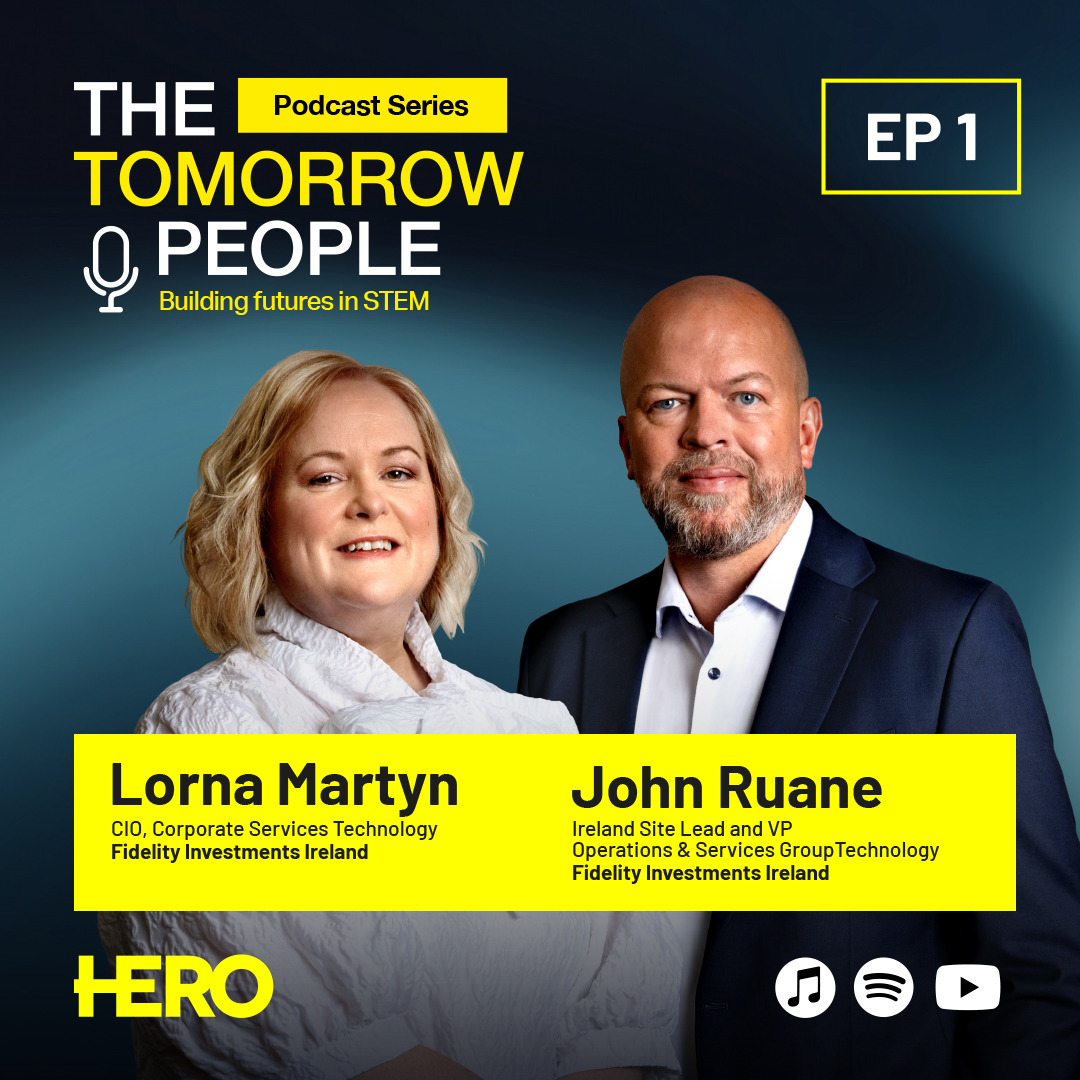
In the opening episode of The Tomorrow People, host Deirdre Finnerty speaks with two leaders from Fidelity Investments: Lorna Martyn, CIO, Corporate Services Technology, and John Ruane, Ireland Site Lead and VP, Operations & Services Group.
Lorna has spent thirty-five years in technology and twenty-two at Fidelity, from graduate software engineer to the C-suite. In that time, she has watched entry-level demand pause at four separate moments of major technological change: mainframes, distributed computing, the internet, and now AI. Her reading of the present moment is that it is another inflection point rather than an ending.
"At every one of those pivots the same concerns and anxiety came in, are my skills going to be redundant, are the jobs going to be redundant? And at every single one of those steps, the market expanded."
John trained as an accountant, joined Fidelity in 2009 and was Chief Financial Officer for the Ireland region before moving into business operations, a function he has now led for eleven years. He sees the same shift from the other side of the hiring desk: the routine work that once taught people their trade is increasingly automated, and that changes how quickly people have to learn.
"Traditionally, you learned your domain by doing. You started with the simple tasks, became expert at that, moved on, and built it up over years. The pace at which we need to learn that is much quicker now, because those simple tasks are in a lot of cases automated."
Between them they give a specific answer to what makes a graduate stand out now. Lorna's advice is practical: go back to the employers who gave you an internship, put your projects somewhere an employer can see them, and make sure your CV speaks to what you are learning independently. She graduated in 1991, when perhaps half her class was employed straight out of college and others took six to twelve months, and she sees little difference in what is happening now. John's test is the appetite to learn: companies, he says, are less focused on what you know and more on how you apply it.
Lorna is also one of Ireland's most consistent advocates for female representation in technology, and she explains why with her own start rather than a statistic. She came out of the University of Limerick as a computer systems graduate into a Bank of Ireland programme of twelve graduates, six women and six men, in an industry so young in Ireland that nobody was counting.
"When I started my career, I wasn't even aware that there was a lack of female representation, because it was a very different time. I really want everyone to have the experience I had early in my career, where you didn't have to worry about advocating for females or indeed for males. It just happened."
Fidelity has since begun a research project with Dublin City University to establish which STEM (Science, Technology, Engineering & Maths) interventions would be most effective, from primary school through to mid-career development, and to share those findings with the wider industry.
John brings the conversation down to daily habits. For him, allyship is about action rather than talk, and about making sure other people get the chance to use their voice. His most practical point is one every manager will recognise: the tendency to keep going back to the same reliable people, when someone else could also be considered for the opportunity and has the skill set.
He also tells the story of a plan that fell through. John was due to build a finance centre of excellence in Ireland until the decision was made to locate it elsewhere. His boss told him to take a couple of days. What followed was a feasibility study for business operations in Ireland, then a team to build, and then a team to lead.
"It's been the most rewarding role I've had. And it started from what at the time felt like a massive setback."
Episode highlights:
- Why entry-level hiring has paused at every major technology shift Lorna has lived through, and expanded again every time
- How automation is removing the simple tasks people once learned on, and why John now looks for the appetite to learn when he reads a CV
- Why female representation in technology matters to Lorna, and the research programme Fidelity has begun to find out which STEM interventions would be most effective
- The specific things graduates can do right now to make their potential visible
- Why John sees allyship as action, not talk, and the habit every manager needs to break
- Whether the four-year degree still holds up, and how apprenticeships, scholar programmes and career changers widen the gate
- What John learned when he stopped being "the expert"
- The plan that fell apart and led John to the most rewarding work of his career, and why Lorna says some of her best moves were sideways
A practical, thought-provoking conversation for anyone starting out, changing direction, leading others, or shaping the workforce of tomorrow.
For more updates, follow HERO Recruitment on LinkedIn, reach out to hello@hero.ie, or explore exciting job opportunities in STEM (Science, Technology, Engineering and Maths): Permanent Job Opportunities and Contracting Job Opportunities.