The Future of Work in Ireland: STEM Recruitment Trends for 2026
Ireland’s future workforce will be shaped by slower labour-supply growth, specialist skills shortages, artificial intelligence, continuous learning and more flexible combinations of permanent and contract talent. Employers will need to focus less on traditional career labels and more on current capability, adaptability and the skills required to deliver specific business outcomes.
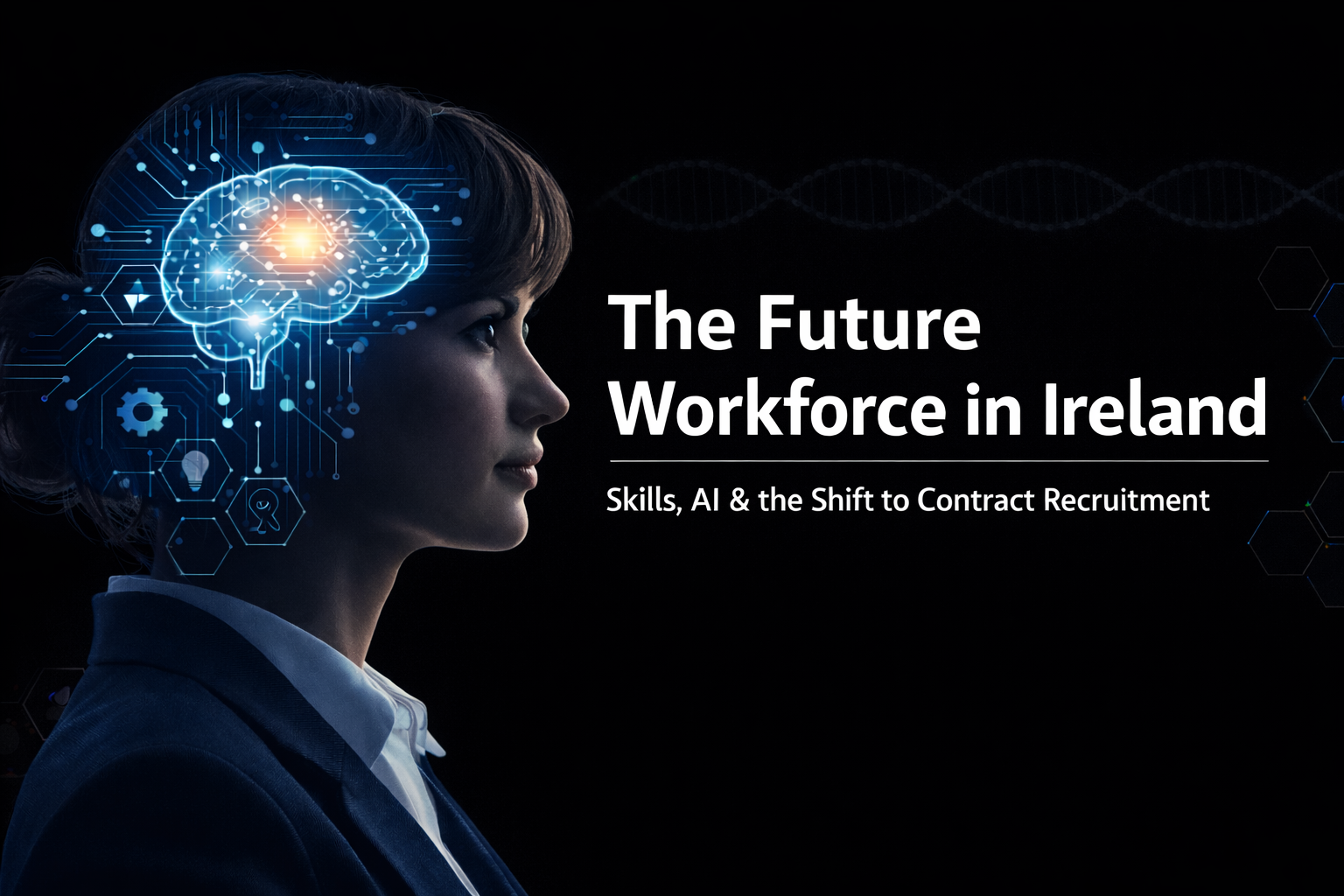
For a long time, the phrase "the future of work” felt slightly distant. Something to prepare for later, rather than something already changing the market.
That is harder to argue now.
Ireland’s labour market remains resilient, but growth has slowed. Approximately 2.79 million people were employed in the first quarter of 2026, virtually unchanged from one year earlier. Employers continue to face shortages in particular occupations, even as the overall market becomes more selective. Enterprise Ireland, 2026
Insight: Tight labour markets do not weaken the case for talent strategy. They sharpen it.
What is taking shape is not one dramatic shift, but several at once. Skills are changing faster. AI is moving into everyday work. Flexibility is becoming structural. And career paths look less linear than they once did.
What Is Changing in Ireland’s Workforce?
A healthy employment market can give an impression of stability. In reality, it can sit alongside a growing mismatch between what organisations need and how talent is assessed and developed.
The World Economic Forum’s Future of Jobs Report 2025 found that employers expect 39% of workers’ core skills to change by 2030, while 63% say skill gaps are the main barrier to business transformation.
That matters in Ireland, particularly across Science, Technology, Engineering and Mathematics (STEM) sectors, where demand for specialist capability remains high and the pace of technical change remains unforgiving.
The traditional career ladder still exists, but it increasingly sits alongside something more fluid: adjacent moves, blended skills, project-led experience, and stronger emphasis on what people can demonstrate in practice.
HERO view: In our view, the market is not moving away from expertise. It is becoming more focused on immediately usable expertise.
Also Check out: EU GMP Updates 2026
How Is AI Changing Jobs and Recruitment in Ireland?
In 2025, 20.2% of Irish enterprises used at least one form of artificial intelligence, up from more than 15% in 2024 and approximately 8% in 2023.
That matters not only because AI is spreading, but because it is becoming part of normal business activity. As more tasks become easier to generate, the value of human contribution shifts. Judgment matters more. So does validation, context, critical thinking, and the ability to apply knowledge in a live setting.
This is especially relevant to STEM recruitment. In technical and regulated environments, polished output is not enough. Employers still need people who can challenge assumptions, interpret nuances, and make sound decisions.
Insight: When output becomes easier to produce, discernment becomes more valuable.
Also Check out: IT Salary Guide 2026 and IT Rate Guide 2026
Is Flexible Working Still Important?
The conversation on flexibility has moved on. It is no longer only about where work happens. It is increasingly about how work is organised.
Hybrid and remote working remain important features of the Irish labour market. But the more significant shift is that work itself is becoming more modular. Teams are built around outcomes. Specialist talent is often needed for shorter periods. Career paths are becoming less fixed.
That has real implications for recruitment.
Permanent hiring remains central. But in many sectors, it now sits alongside a growing need for contract recruitment, project-based talent, and specialist interim capability.
This is particularly visible across STEM industries, where regulatory pressure, technical complexity, and delivery timelines often collide. In those settings, the question is not always whether a business needs talent. It is whether it needs that talent permanently, or whether contract expertise is the better fit for the moment.
HERO view: We increasingly see contract recruitment not as a stopgap, but as a strategic part of workforce design, especially where speed, niche capability, and flexibility matter most.
Check out: Ireland's Job Market 2026
Why Skills-Based Hiring Is Becoming More Important
If skills are turning faster, learning can no longer fit neatly at the start of a career.
The Education and Training Monitor 2025 found that 16% of adults in Ireland participated in learning in the previous four weeks in 2024, above the EU average of 14%. Even so, the pace of change suggests the requirement is rising faster than many traditional development models were built for.
This helps explain why the distinction between credentials and capability is becoming more visible. Qualifications still matter, particularly in technical and regulated roles. But on their own, they are no longer enough.
What increasingly matters is whether knowledge is current, applied, and relevant.
Insight: In a faster-moving market, learning is no longer a stage. It is part of employability.
The Workforce Model is Widening
One of the clearer shifts in the Irish market is that STEM hiring is becoming less tied to one fixed model.
For some organisations, permanent recruitment remains the right answer. For others, especially those managing transformation, scale-up, compliance pressure, or project peaks, contract recruitment offers access to specialist capability without forcing a long-term decision too early.
That is one reason flexible talent models are gaining ground. They allow businesses to respond to demand with greater precision, while giving professionals more varied and often more autonomous career paths.
From HERO’s perspective, this is one of the most important workforces shifts underway in Ireland: not simply a change in hiring volume, but a change in how capability is accessed.
What Employers Should Do Now
Taken together, the signals are fairly consistent. Ireland remains a strong employment market. AI adoption is rising. Skill requirements are evolving quickly. And across the economy, particularly in STEM, there is growing emphasis on demonstrable capability, adaptability, and access to specialist talent in the right format.
That does not mean traditional markers of quality, experience, or leadership are disappearing. It means they are being interpreted differently.
The organisations likely to navigate this best may not be those chasing every workforce trend. More likely, they will be those able to distinguish short-term noise from structural change and build talent strategies that reflect where the market is actually moving.
The future workforce, in that sense, is no longer a distant concept.
It is already reshaping recruitment in Ireland.
If these shifts are raising questions for your organisation, whether around STEM recruitment, contract recruitment, specialist hiring, or workforce planning, get in touch with the HERO team at hello@hero.ie or call +353 91 730 022.
FAQs
Search Jobs
Match my CV
We take the hard work out of finding you a new job. Simply upload your CV (or call us) and we’ll get hunting for you!
Subscribe to The Shift for the latest STEM industry and career updates.

Join The Shift!
Get insider updates on the hottest industry trends, cutting-edge career advice, and exclusive talent insights. Stay ahead of the curve and keep your finger on the pulse of Ireland’s STEM talent trends. Exciting content coming your way soon!