AI and Engineering Jobs in Ireland: How AI Is Changing Who Employers Hire
AI won’t replace your engineers. But it will change who you hire.
Every generation has worried that technology would make people obsolete. Mechanisation changed manufacturing. Computers transformed offices. Automation changed production lines. Artificial intelligence has brought the question back, and this time the impact feels more immediate because many of us can already see the technology changing the work on our own screens.
So, will AI replace engineers?
For most engineering and life-sciences roles, that is the wrong question.
AI is more likely to change what engineers do, which tasks employers value and what someone needs to demonstrate before they are hired. That distinction matters in Ireland, where AI adoption is accelerating at the same time as employers continue to struggle to recruit experienced engineering talent.
Ireland’s Central Statistics Office found that the proportion of enterprises using AI increased from 8.1% in 2023 to 20.2% in 2025. Among large enterprises, adoption had reached 57.7%. AI was already being used for data analysis, decision support, administration, R&D and production processes.
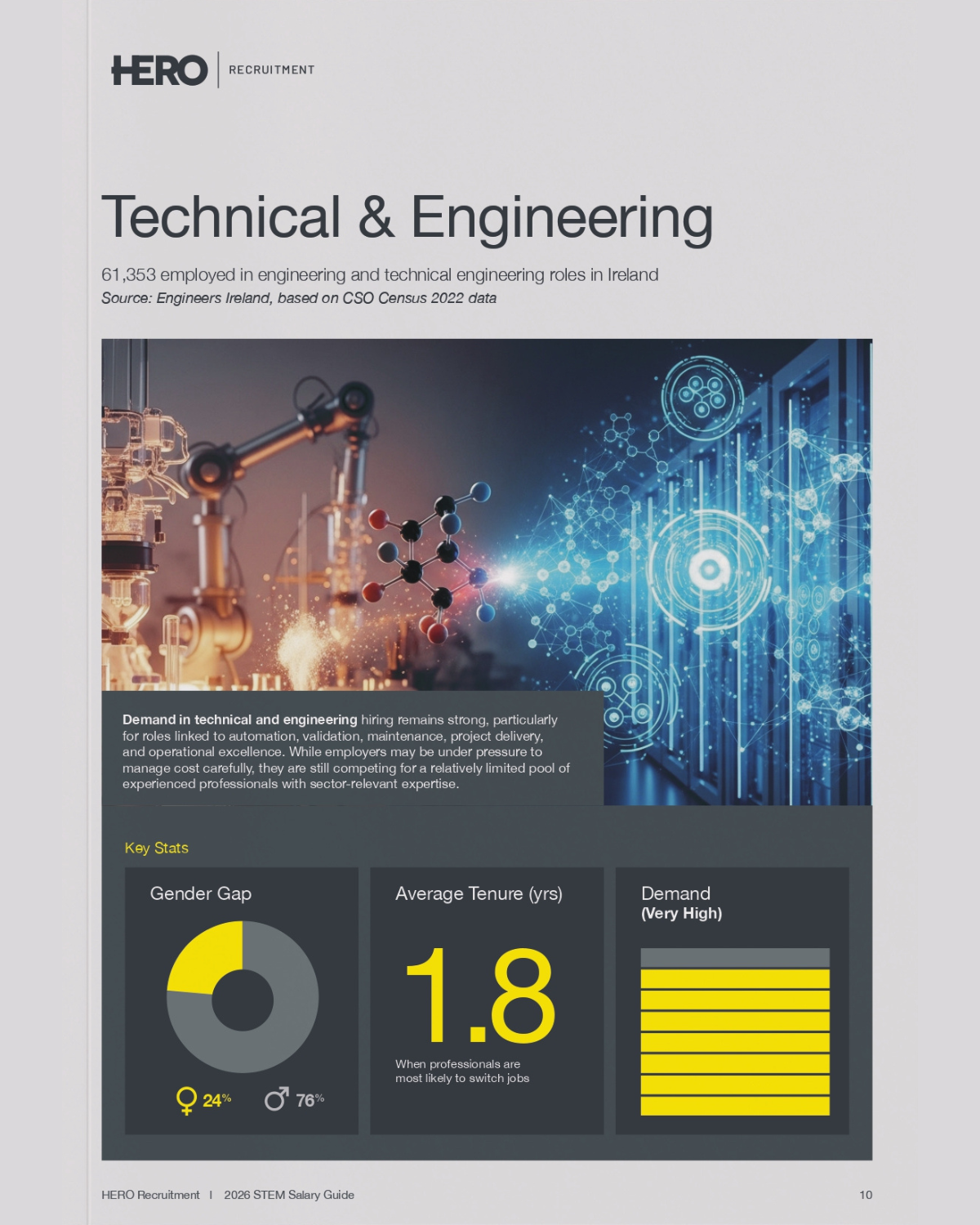
At the same time, SOLAS continues to identify shortages across engineering disciplines including mechanical, electrical, automation, quality, process and design engineering. Employers are looking not only for technical expertise but increasingly for leadership, digital capability, data analysis and AI-related skills.
Will AI Replace Engineers?
Not in the simple way the headlines sometimes suggest.
The OECD’s 2026 research on skills and artificial intelligence makes an important distinction between exposure to AI and risk of automation. Engineers, managers and other highly skilled professionals are among the occupations most exposed to AI because a significant part of their work involves information, analysis and reasoning.
But high exposure does not automatically mean high replacement risk.
Many engineering roles depend on contextual judgement, complex decision-making, communication, responsibility and non-routine problem-solving. Those are precisely the areas where automation is more difficult.
So, the likely outcome is not an engineer disappearing and an AI system appearing in their chair.
It is an engineer doing a different combination of work.
For employers planning their wider workforce strategy, HERO’s guide to the future of work and STEM recruitment in Ireland looks at how AI, skills-based hiring, flexible work and contract talent are already changing workforce planning.
AI Is More Likely to Change Tasks Before It Removes Roles
Almost every engineering job is a collection of different tasks. Consider a validation engineer. They might prepare protocols, analyse data, investigate deviations, write reports, review evidence, coordinate with manufacturing and quality teams and explain findings during an audit.
AI can potentially accelerate parts of the documentation and analysis. That does not mean it can automatically assume responsibility for determining whether the evidence is sufficient, whether an unexpected result matters or whether a process is genuinely under control.
The same distinction appears elsewhere. A manufacturing engineer may use AI to analyse process information more quickly but still need to understand what is physically happening on the line. An R&D engineer may use an AI system to organise technical information but remain responsible for design decisions, risk and testing.
A project engineer may generate a first draft of a status report in seconds while still needing to recognise that the project itself is drifting off course. This is why the OECD describes AI as operating through several channels at once: automating existing tasks, creating new tasks and improving productivity. Evidence so far suggests that AI can complement human labour as well as substitute for parts of it.
The Global Numbers Are Big, but They Need Context
The World Economic Forum’s Future of Jobs Report 2025 estimates that structural labour-market changes could create 170 million jobs globally by 2030 while displacing 92 million, producing a net increase of 78 million roles. Those figures attract attention, but they should be interpreted carefully.
They are based on the expectations of more than 1,000 large employers representing over 14 million workers. They describe how those employers expect the labour market to change; they are not a deterministic prediction of exactly how many jobs will exist in 2030. AI is also only part of the story. Digitalisation, demographic change, the energy transition, geopolitical change and economic conditions are all affecting employment at the same time.
That matters for Ireland.
The future of engineering is not simply a story about prompt engineering or people sitting behind screens. Manufacturing, energy, construction, infrastructure, MedTech, pharmaceutical production and advanced engineering still depend on people capable of understanding physical systems and making decisions in real environments.
The Evidence So Far Does Not Show an AI Jobs Apocalypse
By mid-2026, the employment evidence remained far more nuanced than many headlines suggested. A July 2026 review from Stanford’s Institute for Economic Policy Research found little evidence that AI was already producing significant economy-wide job losses.
Since 2022, unemployment among the most AI-exposed workers in the US had increased by 0.77 percentage points. Among the least AI-exposed workers, it had increased slightly more, by 0.85 percentage points.
Stanford concluded that the pattern looked more like a generally softer labour market than an economy experiencing widespread AI-driven unemployment. That does not mean nothing is happening.
The more subtle changes may matter more to hiring managers. Stanford found evidence of organisations consolidating roles and choosing not to recruit into positions where AI can perform a significant share of the work. It also highlighted signs of greater pressure on younger workers in highly AI-exposed occupations.
That leads to one of the biggest workforce questions created by AI.
AI Literacy Will Matter More Than AI Expertise for Most Engineers
Not every engineer needs to become a machine-learning specialist. That would be an inefficient response to the problem.
OECD research published in 2026 estimates that workers with advanced AI skills remain rare, at around 1% of the workforce. The organisation argues that the much larger requirement is AI literacy: workers need enough understanding to use AI effectively, assess its outputs and understand its limitations and risks.
For professionals building adjacent digital capability, HERO’s guide to high-demand IT skills and upskilling pathways in Ireland covers areas including data, cloud, cybersecurity and emerging technology skills.
What Should Engineering Employers Hire for in 2026?
Hiring managers should begin by separating AI capability from AI job titles. Most engineering teams do not need every employee to be an AI specialist. They need engineers who can operate effectively in an AI-enabled environment. That means looking for technical depth first, then assessing whether the candidate can work intelligently with technology around that expertise.
For an automation engineer, that might mean controls knowledge combined with data literacy. For a validation professional, it might mean strong regulated-industry judgement combined with an understanding of how AI-assisted documentation needs to be reviewed.
For an engineering manager, it may mean understanding enough about AI to decide where investment makes sense while also managing risk, capability development and organisational change. For a graduate, curiosity and the ability to explain how they checked an AI-generated result may become more meaningful than simply claiming to be “proficient in AI”.
Where Contract Engineering Fits
AI is increasing the speed at which some technical capabilities become strategically important. An organisation may decide that it needs stronger capability in automation, manufacturing data, digital validation, systems integration or data integrity well before it has developed those skills internally.
That is one reason project and contract talent can become useful. Contract specialists can provide experience for a defined programme without requiring the organisation to wait until every capability has been built internally. For engineers, contract work can also create exposure to different projects, systems, technologies and organisational environments.
That does not automatically make contracting better than permanent employment. Permanent positions may provide stronger continuity, structured progression and deeper ownership of a system over time. The value depends on the engineer’s goals and the employer’s problem.
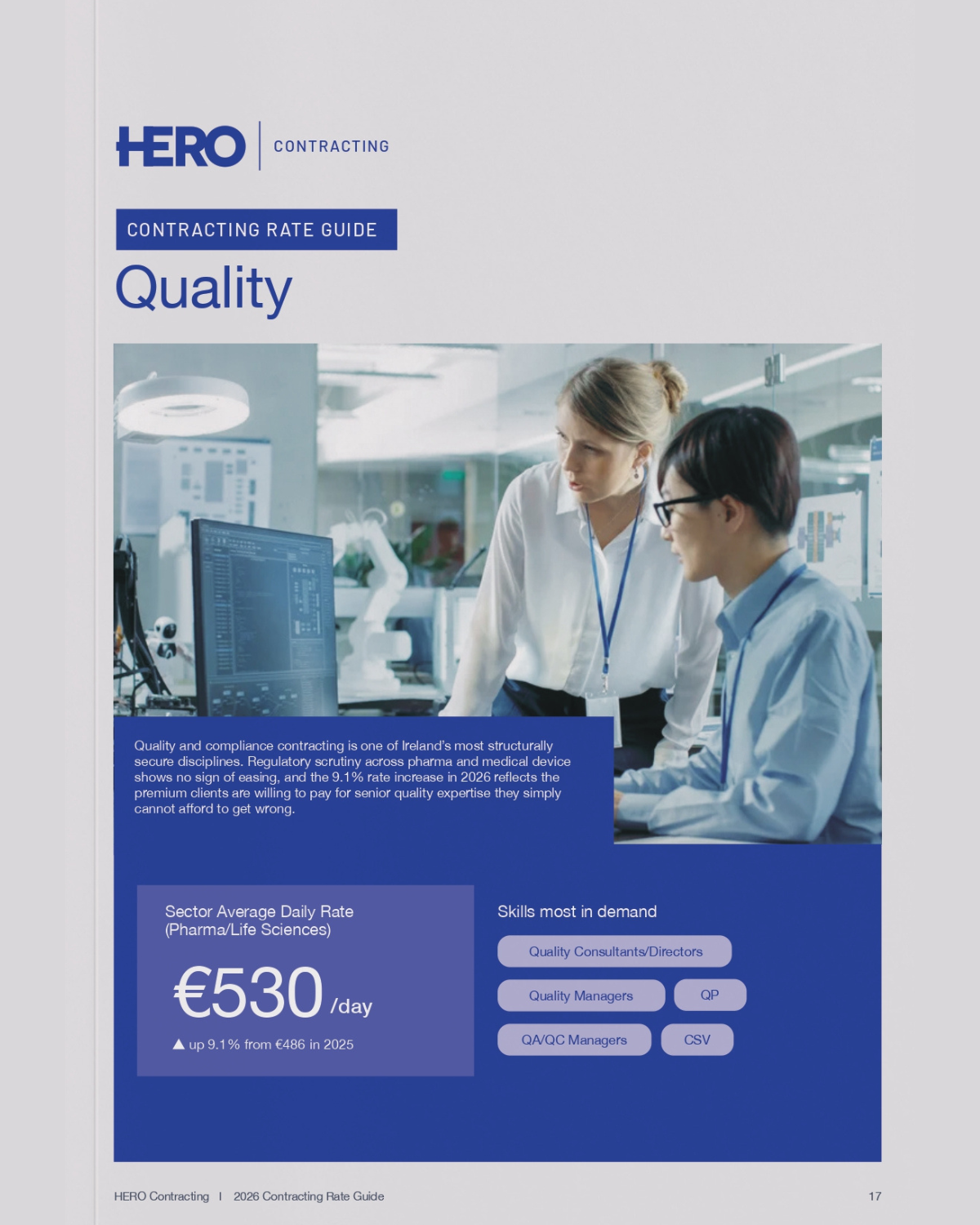
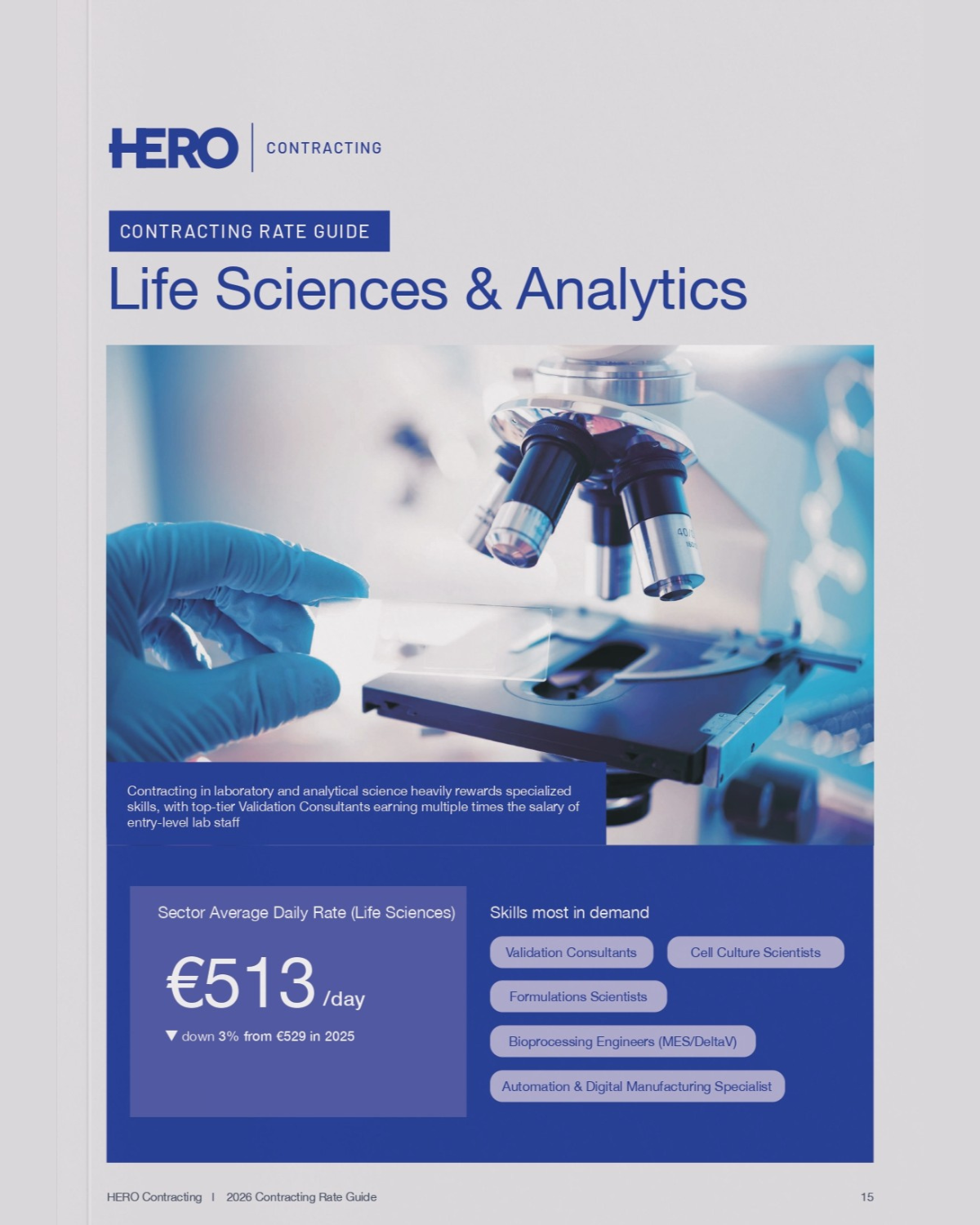
HERO’s guide to why manufacturing engineers in Ireland choose contracting explores that trade-off in more detail, while the Engineering Contracting Rate Guide Ireland 2026 provides current market benchmarks.
Employers considering project-based expertise can also explore HERO’s contract recruitment services.
Explore Engineering Careers and Hiring Support
Professionals can explore HERO’s current engineering jobs in Ireland, compare permanent compensation in the Engineering Salary Guide Ireland 2026 or search all current HERO vacancies.
Candidates who would like to be considered for future engineering, automation, manufacturing, life-sciences and technology opportunities can upload a CV to HERO.
FAQs
Search Jobs
Match my CV
We take the hard work out of finding you a new job. Simply upload your CV (or call us) and we’ll get hunting for you!
Subscribe to The Shift for the latest STEM industry and career updates.

Join The Shift!
Get insider updates on the hottest industry trends, cutting-edge career advice, and exclusive talent insights. Stay ahead of the curve and keep your finger on the pulse of Ireland’s STEM talent trends. Exciting content coming your way soon!