Ireland’s STEM Job Market in 2026: Hiring Trends, Skills and Opportunities
Irish STEM Market Growth: Thriving Opportunities in Ireland

Ireland’s STEM job market remains active in 2026, particularly across medtech, pharmaceuticals, biopharma, engineering, quality, automation and supply chain. However, hiring is increasingly selective, with employers prioritising candidates who combine technical expertise, regulated-industry experience and strong digital or automation skills.
Hiring has become more selective. Employers are prioritising candidates who can demonstrate relevant technical expertise, regulated-industry experience and the ability to deliver measurable results in areas such as quality, validation, process improvement, automation and project delivery.
Is Ireland’s STEM Job Market Growing in 2026?
Ireland continues to have a large and highly skilled workforce, but overall employment growth has slowed.
The Central Statistics Office recorded approximately 2.79 million people in employment in the first quarter of 2026. That represented virtually no annual employment growth, while the national unemployment rate increased to 5% in June 2026 from 4.6% one year earlier.
The figures point to a labour market that is resilient but cooling. Ireland is not experiencing widespread unemployment, but candidates are facing more competition and employers are taking longer to make hiring decisions.
The slowdown has not affected every industry equally. Employment in construction increased strongly during the year to the first quarter of 2026, while employment in information and communications declined by more than 20,000. This means candidates should avoid treating “technology”, “engineering” or “STEM” as a single market. Demand varies considerably by discipline, location, experience and industry.
Within specialist science and engineering occupations, significant skills gaps remain. The National Skills Bulletin identifies continuing shortages in several areas relevant to Ireland’s pharmaceutical, medical-device and manufacturing industries.
Also check out: Future Work in Ireland
Ireland’s STEM market at a glance
- Approximately 2.79 million people were employed in Ireland in the first quarter of 2026.
- National unemployment stood at 5% in June 2026.
- Ireland has more than 300 medical-device companies.
- More than 50,000 people work in Ireland’s medtech industry.
- More than 50,000 people work in Irish biopharmaceutical manufacturing.
- Official skills research continues to identify shortages across science, engineering, quality, automation and technical roles. CSO, 2026
Which Sectors Are Hiring in Ireland?
Pharmaceutical and Biopharma
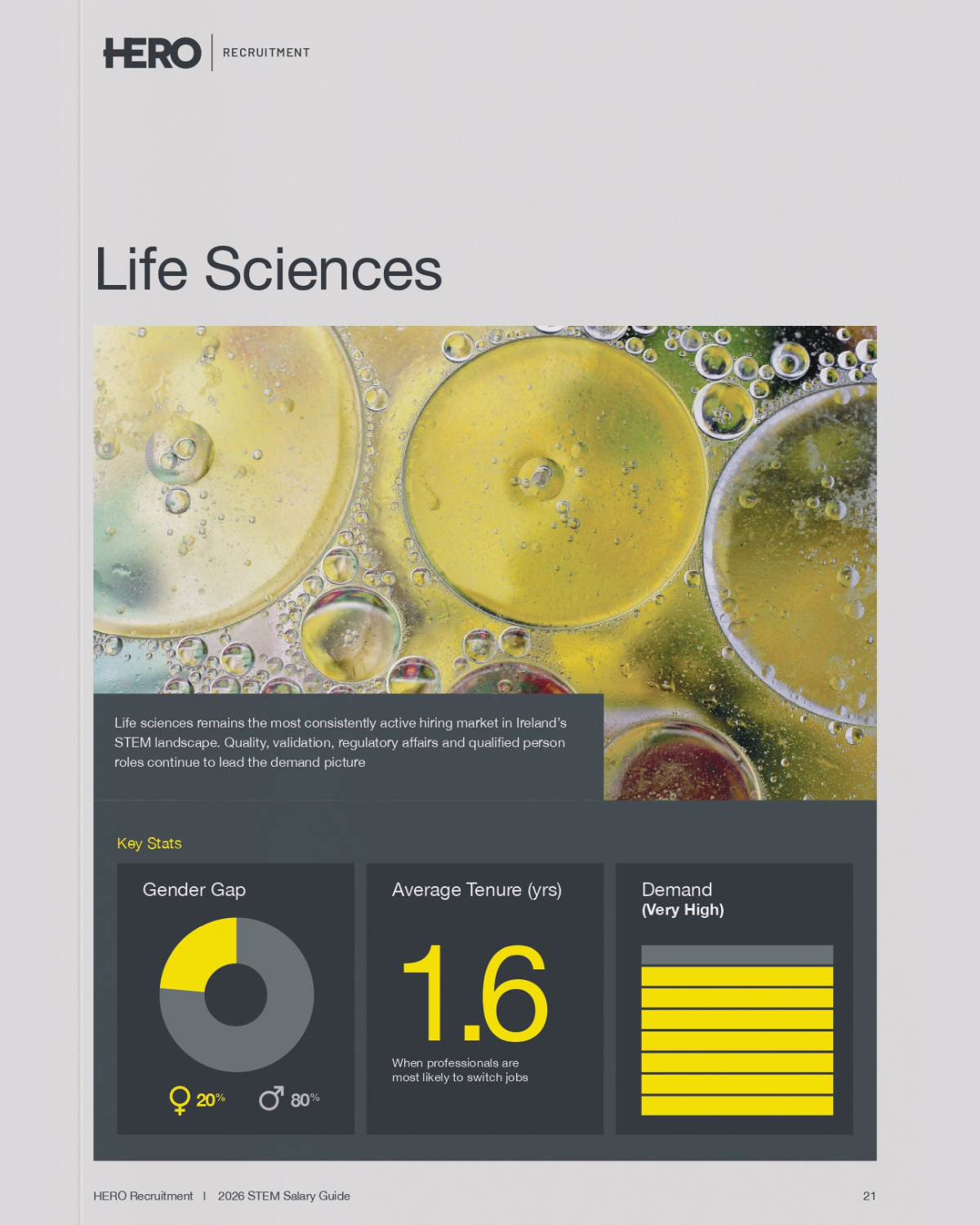
Pharmaceutical and biopharmaceutical manufacturing remains one of Ireland’s most important specialist employment markets.
IDA Ireland reports that employment in biopharma has increased by approximately 20,000 over the past decade to more than 50,000 people. The country has attracted more than €15 billion in biopharma foreign direct investment over the same period and is home to 75 major pharmaceutical plants.
Current opportunities are concentrated around specialist manufacturing, process engineering, quality, validation, laboratory science, maintenance, automation and manufacturing science and technology.
Hiring is not uniform across every company or facility. Some employers are expanding, while others are controlling costs, reorganising teams or concentrating recruitment on business-critical positions. Candidates with direct GMP experience and exposure to regulated production environments are therefore generally better positioned than those relying on transferable skills alone.
Medical Devices and MedTech
Ireland is one of Europe’s largest medical-device employment centres. More than 300 medtech companies operate in the country, employing over 50,000 people, and 14 of the world’s 15 largest medtech companies have operations here.
The industry covers considerably more than traditional device manufacturing. Irish operations now include product development, research and development, process engineering, digital health, software, data, quality systems and advanced manufacturing.
Galway remains one of the country’s most recognised medtech clusters. Continued investment in the region during 2026 has reinforced demand for professionals with experience in R&D, manufacturing, software development, quality and engineering.
Engineering and Advanced Manufacturing
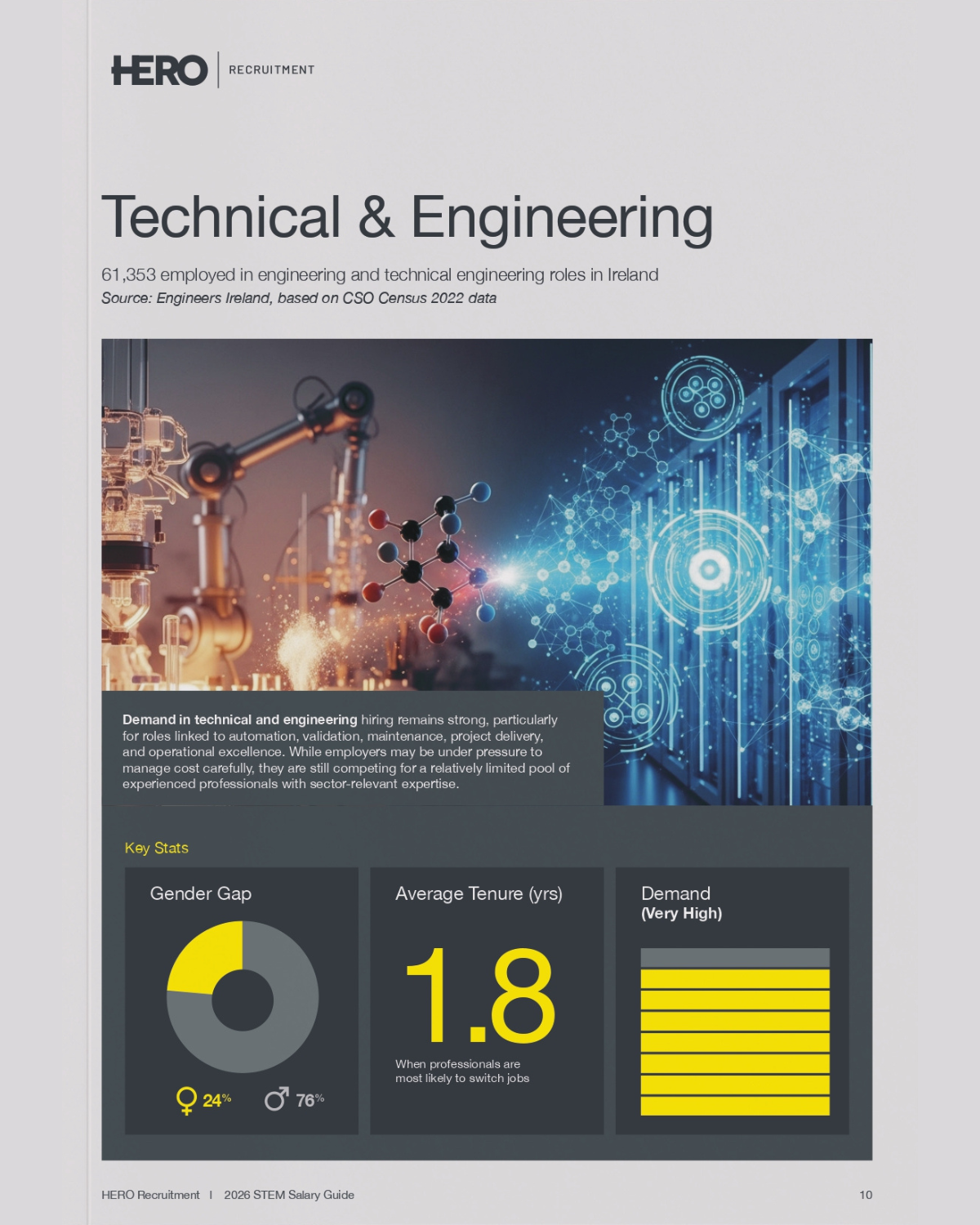
The engineering market is being shaped by automation, digitalisation, sustainability requirements and the continued development of highly regulated manufacturing facilities.
The National Skills Bulletin identifies shortages of quality-control and quality-assurance engineers, process engineers, design engineers, mechanical engineers, electrical engineers and automation engineers. It also reports difficulty sourcing experienced manufacturing, maintenance and laboratory technicians.
Employers are increasingly looking for engineers who can combine technical expertise with project management, continuous improvement, regulatory awareness and effective communication.
A qualification remains important, but experience solving production, quality or operational problems is often what differentiates candidates in a competitive recruitment process.
Also check out: Engineering Salaries Ireland 2026 and Engineering Contract Rates Ireland 2026
Automation and Digital Manufacturing
Automation is becoming central to Ireland’s pharmaceutical, medtech and advanced-manufacturing industries.
Modern production facilities increasingly depend on automated process control, robotics, manufacturing data, digital quality systems and connected equipment. Ireland also hosts a growing range of companies developing and implementing industrial-automation technologies.
Demand is strongest for candidates who understand both technology and the manufacturing environment in which it operates. Relevant skills can include PLC and SCADA systems, process control, equipment integration, industrial networks, data analysis and computerised-system validation.
Artificial intelligence is also beginning to change how Irish employers approach production, forecasting, quality and decision-making. Government research indicates that AI adoption in Ireland is progressing strongly relative to many European peers, although the impact will vary considerably between occupations and industries.
Quality and Regulatory Affairs
Quality remains one of the most dependable areas of STEM recruitment in Ireland because pharmaceutical and medical-device employers must maintain strict regulatory and product-safety standards.
Official skills research has identified shortages involving quality control, quality assurance, quality processes and related engineering capabilities.
Supply Chain and Procurement
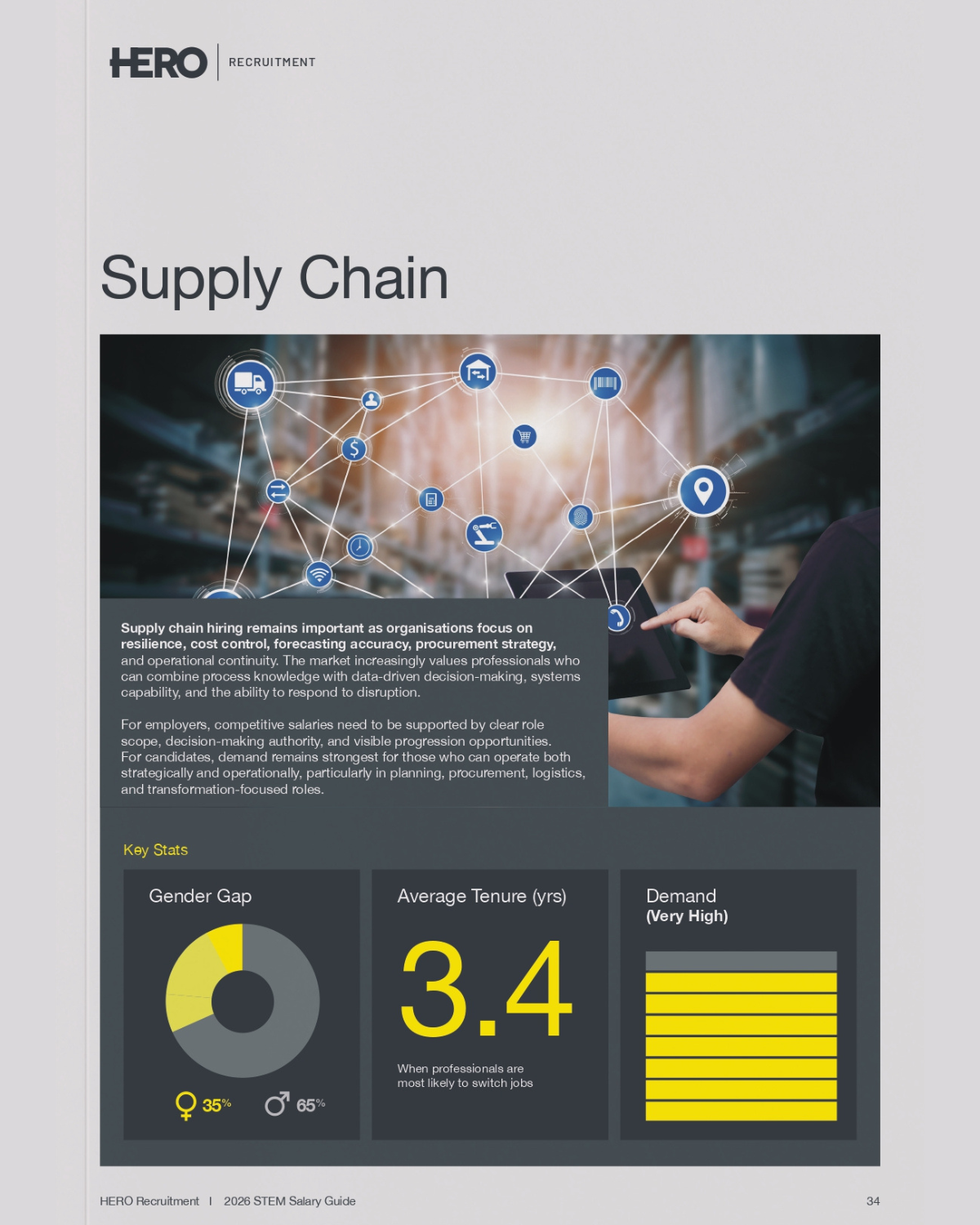
Supply-chain recruitment is more varied than engineering or quality recruitment. Demand exists, particularly within complex manufacturing organisations, but there is not clear evidence of a universal national shortage across every supply-chain occupation.
Employers continue to need professionals who can manage planning, inventory, procurement, supplier performance and operational risk. The strongest opportunities tend to involve regulated manufacturing, specialised products, international supplier networks or major business-transformation programmes.
Also Check out: Supply Chain Salaries Ireland 2026
The Most In-Demand STEM Jobs in Ireland
The strongest official evidence of skills shortages currently relates to the following occupations:
- Analytical, process and medical scientists
- Process engineers
- Quality-control and quality-assurance engineers
- Design and development engineers
- Mechanical engineers
- Electrical engineers
- Automation engineers
- Manufacturing technicians
- Maintenance technicians
- Laboratory technicians
Other roles frequently required within active pharmaceutical, medtech and manufacturing projects include:
- Project engineer
- Manufacturing engineer
- Validation engineer
- CQV engineer
- CSV engineer
- R&D engineer
- NPI engineer
- Regulatory-affairs specialist
- EHS specialist
- Facilities engineer
- MS&T scientist
- Supply-chain planner
Not every vacancy in these categories represents a skills shortage. Demand is usually strongest for candidates with the right combination of industry knowledge, technical experience and location flexibility.
Ireland’s Main Employment Locations
Dublin
Dublin offers Ireland’s broadest mix of technology, life-sciences, engineering, professional-services and corporate roles. It is particularly relevant for candidates targeting international headquarters, digital functions, project management, regulatory, data and technology-related positions.
Competition and living costs can be higher than in other regions, so salary should be considered alongside commuting, housing and working arrangements.
Cork
Cork and the wider Southwest form Ireland’s largest foreign-investment region outside Dublin. The area has established clusters across pharmaceuticals, biopharma, medical devices, technology and manufacturing. IDA Ireland, 2026
Typical opportunities include process engineering, manufacturing, validation, quality, laboratory science, automation, maintenance and supply chain.
Galway
Galway is internationally recognised for medtech, medical-device manufacturing and product development. It is particularly strong for quality engineers, manufacturing engineers, R&D professionals, validation specialists and technical project roles.
Limerick and the Mid-West
The Mid-West has attracted significant investment across high-value manufacturing, pharmaceuticals, biotechnology, semiconductors and professional services.
The region can offer opportunities in automation, manufacturing engineering, process engineering, maintenance, project delivery and quality.
Waterford and the South East
The Southeast has a substantial base of pharmaceutical, medical-device and life-sciences manufacturing operations. Waterford, Kilkenny and surrounding counties offer opportunities across quality, engineering, production, maintenance, science and operations.
Regional hiring should not be treated as secondary to Dublin. IDA Ireland reports that 57% of foreign-investment projects secured during 2025 were located in Ireland’s regions, while more than half of direct IDA-supported employment is now outside Dublin.
Permanent Versus Contract STEM Hiring
Permanent roles generally suit professionals looking for long-term development, organisational stability and a defined progression path.
Contract hiring can move faster than permanent recruitment, but project duration, location, employment structure and continuity of work must be evaluated carefully.
Candidates should compare the complete value of an opportunity rather than focusing only on salary or hourly rate. Pension, annual leave, insurance, travel, taxation, training and time between contracts can materially affect the real value of a role.
How to Find a Job in Ireland
Start by targeting roles that closely match your technical and industry background rather than submitting the same CV to every STEM vacancy.
Your CV should clearly show:
- The equipment, systems and technologies you have used
- The regulated environments in which you have worked
- Projects you have completed
- Problems you have solved
- Measurable improvements you delivered
- Your availability, location and work authorisation
Use terminology that employers are likely to search for, but avoid filling your CV with keywords that you cannot support during an interview.
Candidates from outside the European Economic Area should also review Ireland’s current employment-permit requirements. The Critical Skills Occupations List, updated in May 2026, includes a range of professional engineering, technology and specialist scientific occupations, but eligibility depends on the specific role, qualifications, remuneration and current regulations.
FAQs
Search Jobs
Match my CV
We take the hard work out of finding you a new job. Simply upload your CV (or call us) and we’ll get hunting for you!
Subscribe to The Shift for the latest STEM industry and career updates.

Join The Shift!
Get insider updates on the hottest industry trends, cutting-edge career advice, and exclusive talent insights. Stay ahead of the curve and keep your finger on the pulse of Ireland’s STEM talent trends. Exciting content coming your way soon!