Medical Device R&D Automation: How to Build the Right Team
Medical device companies should normally treat R&D automation as a capability-building programme rather than a single vacancy. Contract specialists can provide implementation and validation expertise during the transition, while permanent hires should retain responsibility for governance, system ownership, continuous improvement and integration with design assurance and quality.
The Talent Decision After an R&D Automation Investment
Ireland has more than 300 medical-technology companies and over 50,000 people employed in the sector. Industry skills research identifies digitisation, data analytics and automation among the sector’s most urgent capability requirements, while research, development and innovation is forecast to be one of its fastest-growing workforce areas. For medical-device employers, this increases the importance of combining automation expertise with validation, design assurance, quality, data governance and long-term process ownership. IDA Ireland, 2026
Medical device companies across Ireland are investing in more automation inside R&D automated testing, smarter data capture, digital workflows, and increasingly, AI-supported development tools. The business case writes itself: stronger traceability, better use of development data, less manual effort, and more consistent processes. Ibec, 2026
Once the investment is approved, leadership teams are often left weighing a more nuanced workforce question. Is the priority an automation engineer? A validation specialist? A design assurance professional with stronger digital capability? Or an R&D engineer with the range to operate across product, systems, and quality?
At that point, the discussion stops being about a single vacancy. The function itself is evolving and the talent model has to evolve with it.
How Automation Changes the Medical Device R&D Talent Mix
Automation rarely sits in one corner of R&D. It touches how requirements are managed, how testing is performed, how outputs are reviewed, how evidence is captured, and how decisions are documented.
That means design control, disciplined review, and confidence in the integrity of the output remain non-negotiable. And where software or AI-enabled tools are introduced, the focus on oversight, traceability, data governance, and explainability gets sharper, not lighter.
For hiring managers, that points to a broader capability shift. The tools may sit at the centre of the change, but long-term success depends on the people who can introduce them well, support them properly, and integrate them into the wider R&D environment.
Also check out: Future of Work in Ireland
Why one hire rarely covers the full requirement
A common response is to try to capture the whole scope in one job spec. The brief ends up asking for automation expertise, validation knowledge, digital systems awareness, documentation discipline, and cross-functional delivery, all in a single hire.
That kind of search tends to stall quickly. The candidates who tick every box are rare, expensive, and usually already employed. A more practical approach is to break the requirement into three stages:
- The expertise needed to introduce the change. Implementation know-how, often deepest where the technology is newest.
- The expertise needed to validate and stabilise it. Validation, design assurance, and the discipline to embed the change properly.
- The capability that should remain in-house long term. Ownership, continuity, and the ability to evolve the system as it matures.
These areas overlap, but they don't always sit naturally inside one person or one permanent role.
Also check out: Candidate's Biggest Frustration finding jobs
When to Use Contract R&D Automation Specialists
Contract support tends to add the most value during implementation.
When an R&D team is rolling out a new automated testing process, a software-led workflow, or a more structured approach to digital data capture, a contractor with directly relevant experience can offer immediate, focused support. They bring knowledge that may not yet exist internally, help the business move with greater confidence, and reduce the risk of early missteps that are costly to unwind.
This is especially valuable when the capability gap is highly specific. In regulated environments, digital maturity depends on governance, technical judgement, and operational ownership as much as the underlying technology. Specialist contract expertise can bridge that gap while the business decides how the capability should sit in the organisation longer term.
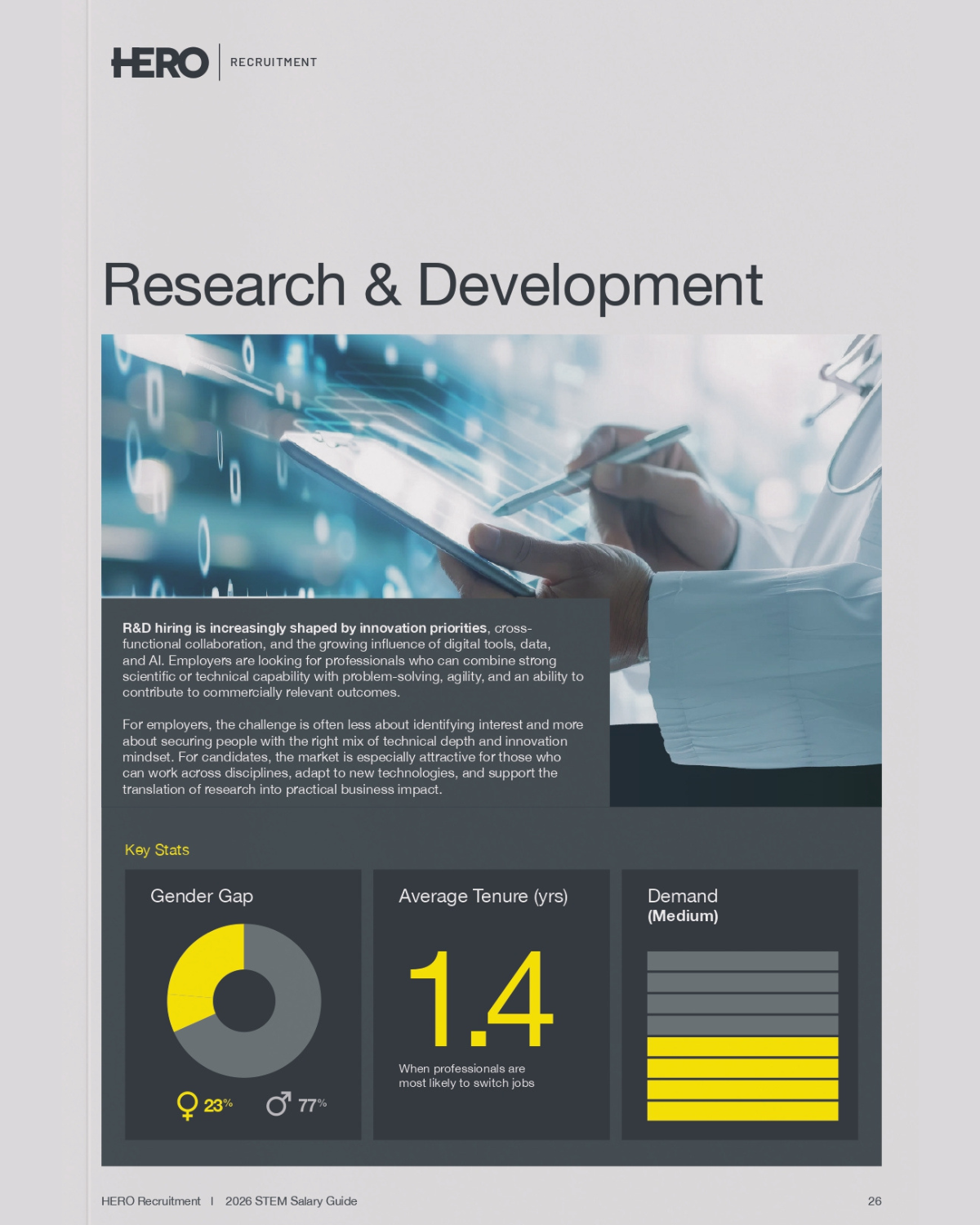
Check out: R&D salary guide Ireland 2026
Which Automation Capabilities Should Remain Permanent
Once the new process or system is established, permanent capability becomes the priority.
That ownership might sit within R&D, design assurance, validation, or a closely connected quality function. The exact home matters less than the principle: someone needs to maintain the process, improve it over time, and hold the technical, operational, and quality threads together.
The permanent hire is often the person who gives the capability stability. They support continuity, embed better ways of working, and reduce reliance on external input as the environment matures.
A stronger way to frame the hiring decision
For hiring managers, it helps to view R&D automation through the lens of capability planning rather than headcount.
Some expertise is needed for a defined phase of implementation. Some is required to validate and strengthen the transition. Some needs sit better with permanent hires who can carry the capability forward.
A measured approach gives the business access to specialist knowledge when it matters most, while building the internal ownership needed to sustain the value of the investment.
If your R&D team is introducing more automation and the hiring need is becoming harder to define, it may be worth reviewing the capability requirement before finalising the brief. For a confidential conversation about your R&D hiring plan, reach out at hello@hero.ie or call +353 91 730 022.
FAQs
Search Jobs
Match my CV
We take the hard work out of finding you a new job. Simply upload your CV (or call us) and we’ll get hunting for you!
Subscribe to The Shift for the latest STEM industry and career updates.

Join The Shift!
Get insider updates on the hottest industry trends, cutting-edge career advice, and exclusive talent insights. Stay ahead of the curve and keep your finger on the pulse of Ireland’s STEM talent trends. Exciting content coming your way soon!